Get Full Government Meeting Transcripts, Videos, & Alerts Forever!
Get email alerts on the Bay Delta Plan topic
No spam. Unsubscribe anytime.
State Water Resources Control Board hears flood of public comment on Bay‑Delta plan; debate centers on voluntary agreements vs. enforceable flow standards
Summary
On Jan. 29 the State Water Resources Control Board took public testimony on the December 2025 revised draft Bay‑Delta Plan and chapter 13. Speakers were sharply divided: fishing and tribal advocates urged stronger, enforceable flow standards; many water agencies and local governments urged adoption of the Healthy Rivers & Landscapes voluntary agreement pathway with built‑in science and adaptive monitoring.
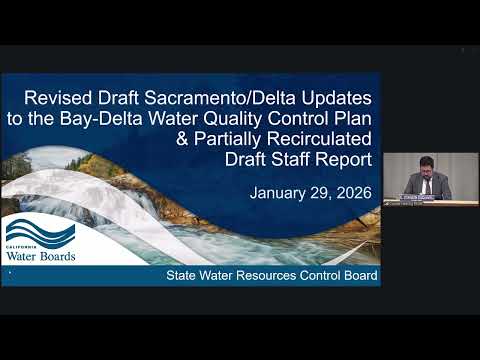
The State Water Resources Control Board convened the second day of a three‑day public hearing on the Sacramento Delta updates to the Bay‑Delta Water Quality Control Plan, hearing hours of panel testimony and more than a hundred public comments on Jan. 29.
Chair Joaquin Escobel opened the session by reminding attendees that the hearing was for oral comments only, that the board would take no action during the workshop, and that written comments on the revised draft plan and chapter 13 are due Feb. 2, 2026. He emphasized that staff will prepare written responses to both oral and written comments before any future adoption vote.
Why this matters: the board is advancing a dual path in the revised draft plan — a regulatory pathway that can impose stricter, unimpaired‑flow‑style standards and water supply adjustments, and a Healthy Rivers & Landscapes (HRL) pathway that relies on voluntary agreements (VAs), coordinated habitat projects, and an adaptive science program. Many speakers said the difference between those paths is whether measurable, enforceable flow protections will be in place sooner rather than later.
Fishermen and conservationists pressed for enforceable flows. John McManus, senior policy director for the Golden State Salmon Association, asked the board to “revisit your document, incorporate action 5, the ITP, think about better benchmarks, and think about legal redress,” arguing that operational changes (including recent federal pumping under Action 5) are not fully reflected in the staff materials. Multiple anglers and charter operators testified that without significant additional flows, salmon runs and the businesses that depend on them cannot recover; Andy Giuliano of the Bay Area charter fleet said, “When you drain the rivers, you aren't just moving water. You're emptying our plates and our pockets.”
Tribes and tribal organizations told the board the draft plan falls short on legal and cultural protections. Wilton Rancheria's Vince Lapena told the board that, while the revised draft recognizes tribal cultural and subsistence uses, “recognition alone does not satisfy the board's legal obligations,” and urged enforceable objectives, mandatory backstops and meaningful government‑to‑government consultation. Multiple tribal speakers pressed for funding and data‑sovereignty protections so tribal science can be integrated on an equal footing.
Local governments and many water agencies defended the HRL/VA pathway. Elected officials from Napa, Solano and Yolo counties said the HRL structure allows regional collaboration and avoids immediate water supply shocks, especially in dry years; several water districts and State Water Project contractors urged the board to incorporate HRL as the implementable way to balance environmental commitments with municipal and agricultural needs. Jennifer Pierre, speaking for HRL parties, described the program as “additive to the system when it matters” and said the HRL parties have proposed enforcement agreements, trial reviews and “red light/yellow light” triggers to address underperformance.
Repeated flashpoints in testimony - Enforceability and benchmarks: Many speakers asked how the board would know if voluntary measures had failed and how quickly it could exercise regulatory remedies. Fishing groups repeatedly asked for clearer, earlier triggers. HRL proponents said they envision eight‑year trial periods with the ability to call a “red light” earlier if monitoring shows failure. - Tribal beneficial uses: Tribes pressed for mandatory protections rather than contingent or advisory measures; they asked for direct funding, co‑decision authority, data sovereignty protocols and fuller CEQA analysis for impacts to living cultural practices. - Evidence and accounting: Several Delta and Delta‑area representatives urged the board to consider historic water right promises, salinity control obligations, and the potential operational interactions with federal projects (Action 5). Delta stakeholders asked for more granular hydrologic modeling of how proposed changes would affect local supplies and salinity.
What the board can expect next: staff will compile oral and written comments and use them to prepare responses and any further revisions ahead of an adoption hearing on a future, publicly noticed date. As Chair Escobel reminded attendees, the board will not decide the plan today.
Board members asked for details on benchmarks and enforcement in follow‑up and invited written proposals. Several panels offered to provide technical benchmark proposals and further modeling for the record.
Holding the record: the hearing transcript and related materials (including peer reviews and the scientific basis reports) are available on the State Water Board website for detailed review. The board’s final decision will hinge on how it weighs long‑term ecological recovery, tribal and public‑trust obligations, water‑supply reliability, and the implementability of monitoring and enforcement mechanisms.