Lifetime Citizen Portal Access — AI Briefings, Alerts & Unlimited Follows
Planning commission approves Lord Heigl House projecting sign variance over neighbor objections
Loading...
Summary
Commissioners approved a variance to allow a projecting sign larger than the 4‑sq‑ft code limit for the Lord Heigl House coffeehouse (vote 6‑0). Opponents warned of driver distraction and parking/market congestion; the applicant said the sign improves wayfinding and will be removable in storms.
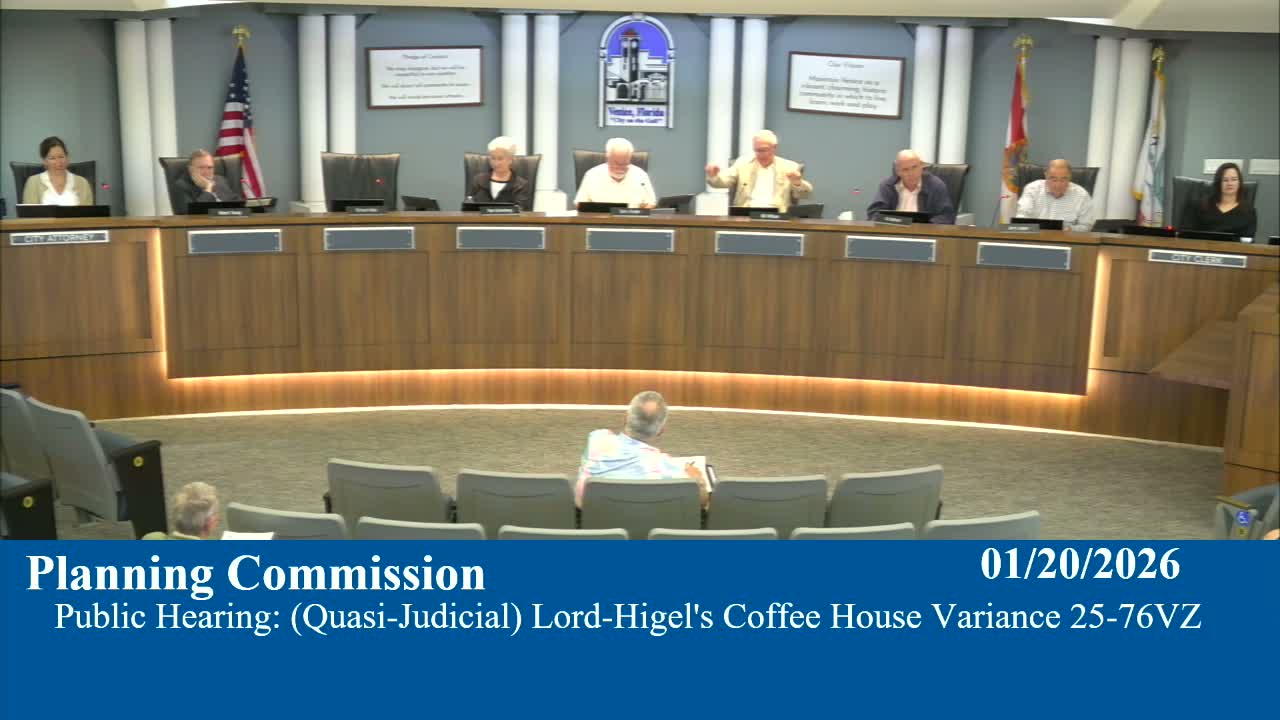
The Venice Planning Commission on Jan. 20 approved Variance Petition No. 25‑76‑VZ to allow a projecting sign for the Lord Heigl House coffeehouse that exceeds the city’s 4‑square‑foot limit. Commissioners found the petition met the seven variance criteria in the Land Development Code and voted 6‑0 to approve the request.
Nicole Tremblay, senior planner, explained the parcel is city‑owned, located in the Island neighborhood historic district, and that the applicant requests a projecting sign of roughly 12.6 square feet on the southwest corner of the building. Tremblay walked the commission through variance decision criteria and the staff analysis, noting the parcel’s small size and unique corner location as relevant to the visibility argument.
An applicant representative (identified on the agenda as agent Alyssa Williams) argued the larger projecting sign is needed because the building sits farther from the road — about 45 feet from the corner — than typical downtown storefronts and that the sign will improve safe wayfinding. She told commissioners the projected sign meets structural wind standards and can be removed for storms.
Howard Burke, a resident who lives across the street from the property, opposed the variance. He said the Lord Heigl House already draws substantial attention and traffic and argued a 12‑square‑foot hanging sign could distract drivers and worsen pedestrian and parking conflicts, especially during the Saturday green market. He cited the city ordinance provision prohibiting signs that "unreasonably divert" the attention of moving vehicles.
The applicant replied the coffeehouse is not open 24/7, the lights are turned off nightly and music is kept low, and that the sign is intended primarily to help visitors identify a new, repurposed historic property that the city publicly leased. After discussion, the commission determined the variance met the code criteria and approved the request.
The variance approval was recorded as a 6‑0 vote. No additional conditioned mitigations (for hours or lighting) were recorded in the commission’s motion.