Get AI Briefings, Transcripts & Alerts on Local & National Government Meetings — Forever.
Study of 20 forensic labs finds widespread low‑level drug residues; balances and benches are hotspots
Loading...
Summary
Researchers who sampled surfaces in roughly 20 U.S. forensic laboratories found detectable drug residues across many work areas but said most measurements fall below current reporting thresholds; they recommend routine background monitoring, targeted cleaning, and procedural changes to protect analysts and data integrity.
Researchers described results from a multi‑laboratory sampling project that measured drug residue ‘‘background’’ on surfaces in forensic laboratories and recommended monitoring, cleaning, and workflow changes to reduce exposure and protect evidence integrity.
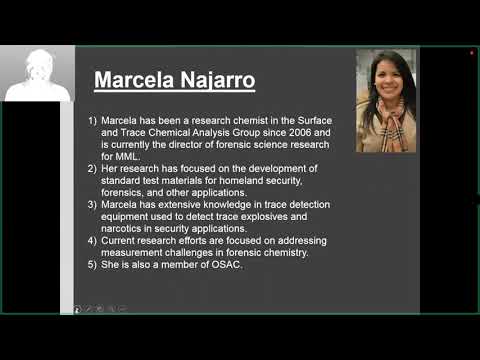
Marcela Najjaro, director of forensic science research for MML, told webinar attendees that ‘‘background is defined as the presence of drugs found on surfaces in a forensic lab, primarily inside of a drug unit,’’ and that the only way to know what and how much residue is present is to measure it. The NIST‑led research team used dry swipes, LC‑MS/MS quantitation, and non‑targeted DART screens across an aggregate sample set described in the presentation as "7 26" samples collected across 20 laboratories.
Ed Sisco (NIST) summarized aggregated findings: cocaine appeared on about 85 percent of sampled surfaces with an average surface concentration near 25 nanograms per square centimeter, and heroin appeared on roughly 75 percent of surfaces with an average near 50 ng/cm2. Most other drugs trended toward concentrations below 1 ng/cm2, Sisco said. He cautioned that balances, benches and keyboards—especially analyst‑specific workspaces—showed the highest probability and average concentration of background, and microscopes and some overlooked equipment also showed elevated levels.
Sisco also presented a limited‑detection study showing that typical laboratory reporting thresholds (the presenters used a 200,000‑count abundance as an internal threshold) and instrument limits of detection vary substantially across instruments and methods. He said that "almost all of those surfaces...fall below even the lowest reported meniscus line" on the lab’s averaged reporting‑limit plots, and concluded that, with current standard GC‑MS methods, ‘‘the likelihood of actually reporting background is extremely low.’’ He added that adopting more sensitive, trace tools (for example, DART mass spectrometry) would make background more visible and could change monitoring strategies.
Marcela Najjaro reported on cleaning‑agent experiments: four cleaning approaches tested in bench and tile trials removed a large fraction of particulate and residues (the team reported ~97–98% particulate removal and >95% removal for certain synthetic opioids on tile), but some intact opioid remained in cleaning solutions, so responders and labs should treat wipes and liquid waste as contaminated.
Presenters said participating laboratories had used study findings to replace high‑background benches, advocate for improved PPE and air handling, and design targeted cleaning and monitoring programs. The presenters encouraged labs to determine instrument limits of detection before starting routine background monitoring and to run procedural blanks to protect data integrity.
The project team made slide decks and publications available after the webinar and offered to consult with laboratories planning implementation. Webinar presenters included Marcela Najjaro (MML), Edward Sisco (NIST), Amber Burns (Maryland State Police), and Robert Kirkby (Michigan State Police).