
Alabama Supreme Court Weighs Scope of State Reporter Shield in New York Times Case
Get AI-powered insights, summaries, and transcripts
Subscribe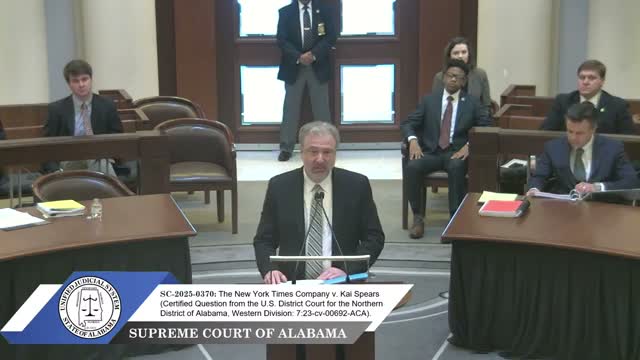
Summary
In a certified-question hearing, the court considered whether Alabama's shield statute protects information that would reasonably identify a confidential source and whether it covers publications appearing both in print and online. The court discussed standards such as "reasonably likely" and in-camera review and took the matter under submission.
The Supreme Court of Alabama heard argument in The New York Times Company v. Kai Spears on whether Alabama's reporter shield statute protects information that would reasonably identify a confidential source and whether that protection extends to a newspaper published both in print and online. Chad Bowman, arguing for the Times, said Alabama's statute was enacted to encourage sources and that courts should protect not only names but documents and other details that would "reasonably identify" a confidential source.
Why it matters: the questions the court is resolving were certified from the U.S. District Court for the Northern District of Alabama and bear on discovery in a defamation/negligence suit brought by Kai Spears. Spears's counsel, Matt Glover, told the court the Times's article repeatedly stated as fact that his client was in a car with a murder weapon and that at least one anonymous source later equivocated. Glover said the plaintiff needs access to information about the sources' knowledge and basis to pursue negligence and punitive damages claims.
Bowman proposed a context-dependent test that would bar compelled disclosure of information that would "reasonably lead to the identification of a source" and pointed to other jurisdictions and precedents that protect not just names but facts and metadata that would narrow the universe of potential sources. Glover urged a narrower, textual construction: the statutory protection should be limited to the identity of a source (the name) and facially identifying items such as phone numbers or email addresses, and that information about whether a source had firsthand knowledge should not be cloaked automatically.
The bench also discussed practical case management tools, including in-camera review and how trial judges should apply any standard the court adopts. The justices considered whether to rephrase the certified question and debated standards phrased as "reasonably likely," "highly likely," or "facially identifying." No ruling was announced; the court took the certified questions under submission.