Alabama Supreme Court Hears Challenge Over Parole Eligibility in Pharmacy Robbery Case
Loading...
Summary
In Ex parte Antonio Spencer, the court considered whether the Habitual Felony Offender Act (HFOA) or the pharmacy robbery penalty controls parole eligibility for a life sentence. Petitioner's counsel said the trial court failed to exercise mandatory discretion; the State urged a harmonious reading. The court took the case under submission.
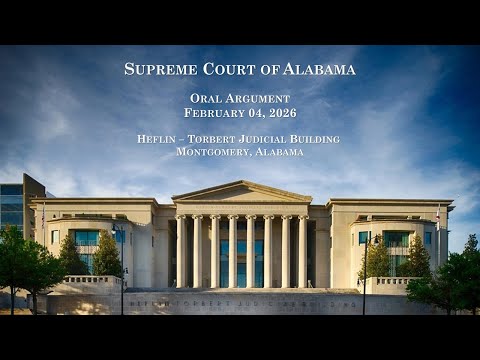
The Supreme Court of Alabama heard argument in Ex parte Antonio Spencer over whether the Habitual Felony Offender Act or the pharmacy-robbery penalty statute governs parole eligibility when a life sentence is imposed. Petitioner's counsel, Chris Young Peter, told the court the trial judge "did not exercise the mandatory discretion" required by the HFOA and that the Court of Criminal Appeals erred by treating life-without-parole as mandatory.
Why it matters: the dispute turns on how two criminal statutes interact. The HFOA (cited at argument as section 13a-5-9(c)(3)) provides that a defendant convicted of a Class A felony with three or more prior felonies "must be punished by imprisonment for life or life without the possibility of parole in the discretion of the trial court." The pharmacy robbery statute (argued as section 13a-8-52) sets a baseline 10-to-99-year term and, in subsection a, states a term in that range "is not parole eligible." Petitioner argued those provisions address different questions and that the HFOA requires the trial court to decide whether a life sentence should include parole eligibility.
State counsel George Muirhead urged a different reading, telling the court the statutes should be read harmoniously: start with the pharmacy robbery baseline and then apply the HFOA as an enhancement. "The HFOA then enhances the baseline penalty," Muirhead said, arguing that a harmonious construction preserves each statute's effect without producing absurd results. He relied on precedent and statutory context to distinguish cases involving general enhancement statutes from the pharmacy-robbery statute's more specific language.
Justices pressed both sides on practical effects and separation-of-powers concerns. Several justices asked whether a trial court could or should purport to limit the executive-branch parole board's authority; counsel agreed that parole decisions are executed by the Board of Pardons and Paroles but said sentencing language can determine eligibility downstream. The bench also explored hypotheticals about whether the HFOA effectively replaces the term-of-years structure and how to reconcile differences in statutory wording such as "shall" and "must."
No decision was announced. The court took Ex parte Antonio Spencer under submission for later resolution; the bench noted Justice McColl is recused from the matter because he sat on the court below.