Lifetime Citizen Portal Access — AI Briefings, Alerts & Unlimited Follows
City staff briefs Ithaca City Common Council on Planned Unit Development process and local examples
Loading...
Summary
City planning staff explained what a Planned Unit Development (PUD) is, reviewed three local PUD examples (Founders Way, Cayuga Park, South Works/Chain Works), outlined the multi-step review process and community-benefit expectations, and answered council questions; a motion for a 5-minute recess was made (vote not recorded).
A city planning staff member told the Ithaca City Common Council that the city expects up to two Planned Unit Development (PUD) applications in the coming months and provided a step-by-step briefing to prepare council before specific proposals arrive. “A planned unit development is, a new zone or zones that allow for, more creative use of land than is currently allowed under current zoning,” the staff member said.
The presentation explained that a PUD is project-specific zoning adopted by council that creates its own area requirements and uses for a particular development. Staff said PUDs must demonstrate long-term community benefits, be compatible with the city’s comprehensive plan, and protect community health and welfare. Staff contrasted PUDs with variances handled by the Board of Zoning Appeals, noting that variances grant narrow, legally bound relief while PUDs are considered and approved (or denied) at the council’s sole discretion.
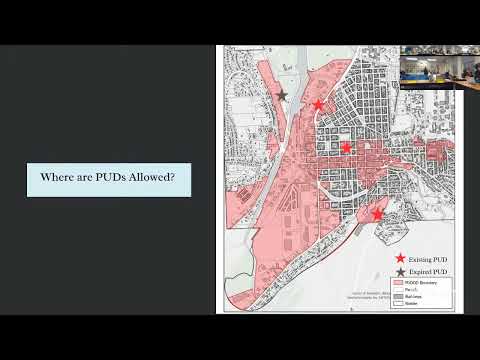
Staff reviewed three local PUD examples to illustrate typical community benefits. Founders Way (the former Immaculate Conception School site) included adaptive reuse of an existing building for housing and nonprofit services and the subdivision and planned sale of the gymnasium to GIAC as a community benefit. Cayuga Park (formerly Carpenter Park), approved in 2001, incorporated the Ithaca Community Gardens into the development through a land swap, added pedestrian and bike crossing improvements on Route 13, included a medical facility within city limits that staff said is expected to generate about 150 permanent jobs, and provided housing with 20% permanently affordable units. The Chain Works / South Works project converted a vacant, contaminated industrial site into a mixed-use neighborhood that required site remediation, proposed roughly 900 or more housing units, and provided public open space, trails and an easement linking Aurora Street to the Gateway Trail.
On procedural steps, staff outlined pre-application meetings with staff and ward representatives, formal application submittal, a public information session (with mailed notices to property owners within 500 feet), internal agency circulation for comments, council conceptual approval, site plan review and environmental review by the Planning and Development Board (which staff said can take four months to a year depending on complexity), and final council action to adopt the PUD as a new zone in the city code if approved. Staff emphasized that council may add conditions or amendments during the review and that the process includes multiple opportunities for public comment.
Council members asked follow-up questions. One asked how long community benefits are enforceable and whether proposed benefits are measurable; staff acknowledged some benefits can be hard to measure and noted projects have returned to council when proposed benefits could not be delivered. A council member asked for a list of past PUD projects; staff said the three examples presented are the primary ones and agreed to send a project list. Another council member asked whether the housing element of the Cayuga Park project was taxable; staff said the housing is separate from the medical center and this is a question council should consider in future evaluations.
Toward the end of the meeting a council member moved for a five-minute recess and another council member seconded the motion. The transcript records the motion and second but does not record the vote or the outcome.
Staff said they would share the full slide deck and more detailed materials for council reference and that staff will return to review any actual PUD proposals as they progress through the site plan and environmental review stages.
The briefing concluded with council discussion about whether to expand the PUD overlay across a larger portion of the city to reduce developer risk; no formal decision on changing the overlay was made during the session.