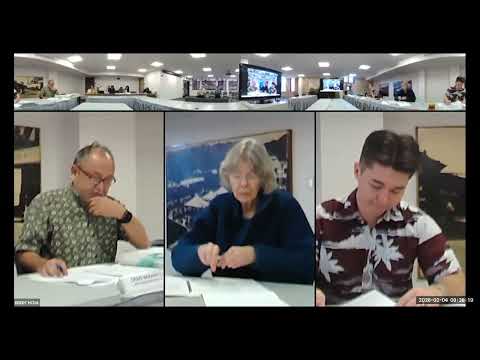
Hawaiʻi Community Development Authority adopts 2026 legislative positions, delegates testimony to executive director
Summary
The Hawaiʻi Community Development Authority on Feb. 4 adopted general policy directions on 2026 state legislation affecting HCDA and authorized Executive Director Craig Nakamoto to track, draft, submit and present testimony. The board highlighted bills on stadium planning, housing programs, permitting and a proposed Chinatown community center and approved the motion 14–0 with three excused.
HONOLULU — The Hawaiʻi Community Development Authority voted Feb. 4 to adopt a set of general policy directions for legislation introduced during the 2026 session and delegated the executive director to track, draft, submit and present testimony consistent with those positions.
The motion, moved by Member Evans and seconded by Vice Chair Sheehy, passed by roll call vote 14–0 with three members excused. The adopted directions instruct the executive director to: support measures that improve infrastructure planning, design or construction within or outside HCDA districts (including transit-oriented development zones); support measures that assign HCDA new responsibilities only if implementing resources are provided; comment on or oppose measures that may have adverse effects on HCDA; and otherwise take positions consistent with past similar legislation.
Executive Director Craig Nakamoto briefed the board on a set of priority bills HCDA is monitoring or intends to comment on. He told members the agency will examine whether previously completed environmental reviews need supplementation in response to Senate Bill 489 (and companion House Bill 742), which would require an environmental impact statement for areas including Iwilei/Kapalama and the UH–West Oʻahu area. "We will be doing that for Iwilei Kapalama, I think," Nakamoto said during his overview.
Nakamoto also highlighted several bills that could affect HCDA operations and projects: Senate Bill 2001 (a proposed Banyan Drive community development district, tied to a $1,000,000 master-planning appropriation), Senate Bill 2061 (changes to Act 97’s 99‑year leasehold program — HCDA previously paused a project while $15,000,000 remains available), bills that would expedite permitting by potentially exempting state projects from county permitting (SB 2066), and measures tied to stadium-area planning that would make HCDA the zoning/entitlement authority for a Halawa Community Development District. On the stadium-related work, Nakamoto noted a bill provision appropriating $4,000,000 for planning and said HCDA would likely hire consultants if the appropriation is enacted.
The board discussed policy and capacity questions. Vice Chair Sheehy and other members pressed for clearer delineation of roles among the city, the stadium authority and HCDA and raised staffing concerns if HCDA is assigned entitlement responsibilities for a major state project. Nakamoto responded that "in a lot of ways, that's what HCD was formed to do — to collaborate with city, private sector, [and] other state agencies," but acknowledged coordination and staffing would be challenging.
Other bills covered in the presentation included proposals to establish a pro‑housing scoring program (SB 2422/HB 1922), an affordable‑housing land‑inventory task force (SB 2068), requirements tied to a Chinatown community action center with a proposed $4,000,000 city match (SB 2918 / SB 3005 / HB 220), and a summer‑streets grant program HCDA would administer for counties (SB 3029). Nakamoto said HCDA will generally submit comments on measures that stretch the agency beyond core redevelopment activities and will coordinate with lead agencies such as the Office of Planning and Sustainable Development and HHFDC where appropriate.
The motion approved by the board authorizes the executive director or his designee to act on the board’s adopted positions for bills listed in the agenda and to apply the stated general directions for measures not listed. The board received no public testimony on the agenda item. The meeting adjourned at 10:05 a.m.; the next item on the agenda was the executive director’s monthly financial report.
"There's a lot of bills introduced; bill tracking and testimony is a team sport," Nakamoto told the board as he closed the briefing.
AI generated
The text on this page is AI generated. Summaries, highlights, analysis, and video transcripts are all produced from the original source material.
AI can make mistakes, so if you spot one, and we will fix it for everyone.
Note: the source content is unaltered by us. Any content source we link to, be it a video, an audio recording, or a document, is presented exactly as its publisher released it. That publisher is usually a government body, sometimes an individual official or another organisation.