Lifetime Citizen Portal Access — AI Briefings, Alerts & Unlimited Follows
Committee advances bill to relocate Bob Oak Game Farm after nitrate detections in sole-source aquifer
Loading...
Summary
The House Agriculture and Natural Resources Committee reported substitute House Bill 2668 out with a due-pass recommendation after testimony that nitrates linked to the state-run Bob Oak Game Farm have contaminated wells in a Centralia-area sole-source aquifer, threatening municipal supplies and public health.
Representative Ed Orcutt, the bill—s prime sponsor, told the House Agriculture and Natural Resources Committee that Substitute House Bill 2668 would start a multi-step process to move the state-run Bob Oak Game Farm off a sensitive aquifer and fund remediation of the current site.
"I support maintaining a game farm. I support the programs that the game farm supports," Orcutt said, adding the bill is "to relocate the game farm" rather than shut it down. He told the committee some downstream wells show nitrate readings multiple times the federal limit and said the relocation process will require time and funding.
The proposed substitute requires the Department of Fish and Wildlife to identify alternate locations that do not pose "a material risk of contaminating municipal or residential drinking water supplies," report those options to the legislature and request predesign funding in the 2027-29 capital budget; the agency must later submit capital requests to complete relocation and remediation work.
Local officials and public-health experts urged the committee to act. Mike Thomas, city manager of Centralia, said point-of-use filters and planned water and sewer extensions are interim steps but do not remove the source of contamination. "We have a city of 20,000 people with one aquifer supporting all of them," Thomas said, urging relocation to protect potable water for decades.
Andy Oian, Centralia—s public works director, described a nitrate plume and said a 2025 investigation found levels "nearly four times" the federal safe-drinking-water limit. He said the city is using a $5,000,000 state grant to plan extensions for about 50 households, but relocation is "the right path to protecting our drinking water."
County and tribal voices framed the issue as both a public-health and cultural concern. Madeline Goddard, a member of the Confederated Tribes of the Chehalis Reservation, said groundwater "is life" and urged action to protect schools, senior facilities and community spaces that rely on the aquifer.
Public-health officials explained health risks. Jeff Landrum, a registered environmental health specialist and state-licensed geologist with Lewis County Public Health and Social Services, said several private wells exceeded the federal drinking-water standard of 10 milligrams per liter and cited RCW 90 54 1 40 directing agencies to treat protection of a sole-source aquifer as an uppermost priority. Dr. Joe Wiley, a retired pediatrician serving as the county public-health officer, described the clinical risk that elevated nitrates pose to infants.
Centralia—s water operations manager, Chris Stone, told the committee the aquifer is the primary source of nitrate contamination and the sole source of drinking water for about 20,000 people; he warned that failure to act could force the city into pursuing a greater-than-$50 million nitrate-treatment facility.
Committee members discussed short-, mid- and long-term remedies during the hearing. Witnesses described immediate distribution of point-of-use carbon filters (one per household), an intermediate plan to extend water and sewer lines for affected households (construction plans underway with a goal of implementation in 2026 and completion by about 2027), and a long-term relocation and remediation process driven by HB 2668.
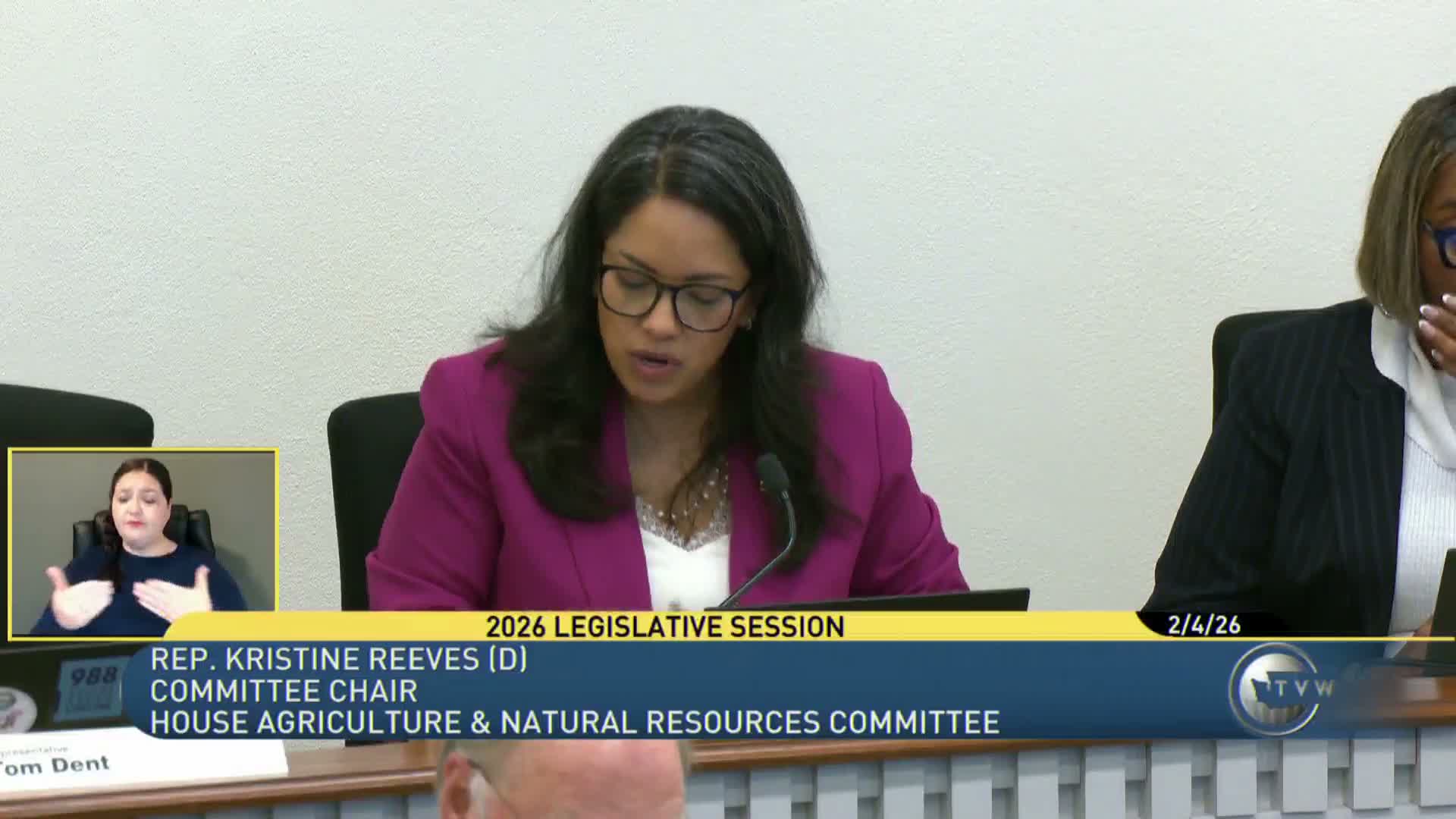
After public testimony, the committee voted to add HB 2668 to the executive calendar and, in executive session, reported the substitute bill out of committee with a due-pass recommendation by voice vote (11 ayes, 0 nays). The record also shows 52 pro and 1 con written registrations not testifying.
The substitute bill sets a multi-year, multi-budget-cycle path: identifying alternate sites, submitting predesign requests in the 2027-29 capital budget, completing predesign and relocation reports, then seeking funding in subsequent capital cycles for relocation and remediation work.
Next steps: the bill, having been reported out of committee, moves to further floor or fiscal scheduling as determined by legislative leaders and the calendar.