Get Full Government Meeting Transcripts, Videos, & Alerts Forever!
Get email alerts on the Community Engagement topic
No spam. Unsubscribe anytime.
Fairfax County presents Springfield–Franconia engagement results and draft vision; residents push for clearer language on safety, equity and 'sustainability'
Summary
SmithGroup and Fairfax County staff summarized outreach for the Springfield–Franconia study area—more than 300 people engaged—then reviewed a draft vision and guiding principles. Participants supported walkability, parks and mixed‑use development but asked staff to clarify 'green/sustainable' wording and to add explicit references to neighborhoods, safety and equity.
Fairfax County planning staff and consultants reviewed community engagement findings and a draft vision for the Springfield–Franconia study area during an advisory meeting, then invited public and advisory feedback on wording and priorities.
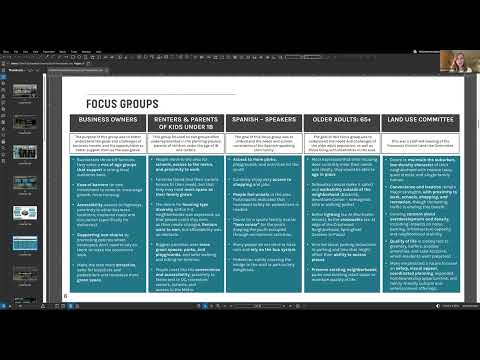
SmithGroup consultant Nick Martanassi told the advisory group the outreach connected with "over 300 people" and produced more than 200 feedback opportunities from three community meetings, five focus groups and an online survey. He said recurring priorities were pedestrian safety and multimodal access, a stronger sense of place, a broader mix of housing options alongside protection of existing neighborhoods, and more tree cover and park space.
Katrina, a county staff presenter, read the proposed draft vision: "the area will transform into a green, sustainable, more walkable, and connected place with added housing and a mix of uses to serve residents, employees, and visitors," and described supporting principles to expand sidewalks and bike infrastructure, improve transit connections and add parks and street trees.
Advisory members and participants praised the emphasis on walkability and mixed‑use opportunities but raised several specific concerns. Gail and other participants asked that surrounding neighborhoods be explicitly supported in the vision; Linda Hallman urged stronger language on safety and security. Steve Levinson pushed back on the choice of the words "green" and "sustainable," asking what metrics would be used and suggesting those terms can be perceived as vague or loaded: "What does 'green' mean? Is that you can't have plastic bottles or you're gonna ban plastic bags?" Katrina said the guiding principles and later design work will include measurable sustainability practices and implementation details.
Speakers also sought clarification of technical terms used in the draft principles. Staff explained "multifamily" as an umbrella term for apartment or condominium buildings and described "transit ready" planning as designing sites and corridors to accommodate transit now rather than retrofitting later—examples include locating stops and providing the density or street design to support frequent bus service or other transit modes.
The workshop exercises—preserve/enhance/transform boards and dot‑voting—showed local priorities: parks and open space, small retail and restaurants, trails and street trees ranked highly; hotels, large office and large‑format retail received fewer preferences. Participants also raised concerns about maintenance (trash and shopping carts), community input on public art (mural selection drew mixed reactions), and protecting nearby environmental resources such as Lake Accotank and local environmental quality corridors.
Staff did not present or take any formal votes at the session. They said they will resend the presentation materials, accept written comments by email, and return to the advisory group at an in‑person meeting on Feb. 23 to review three draft scenarios that translate the principles into spatial options.
The advisory meeting closed after scheduling next steps and inviting additional written feedback.