Committee drops MSSM tuition mandate, advances funding for Maine School of Science and Mathematics
Loading...
Summary
The committee voted to remove a proposed requirement that sending SAUs pay tuition to MSSM and instead advanced amended appropriations totaling roughly $1.05M in FY 26‑27 (one‑time + ongoing increases) to address MSSM shortfalls; members debated per‑pupil costs and residency/subsidy statute implications.
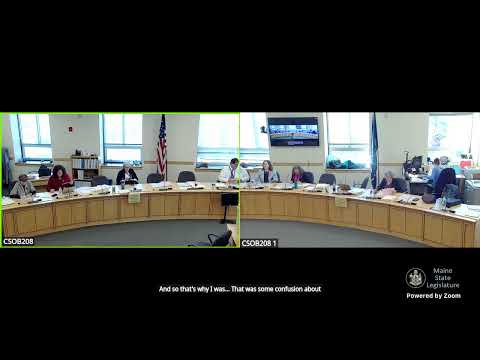
The Joint Standing Committee on Education and Cultural Affairs voted in work session to report LD 2008 "ought to pass as amended," stripping a provision that would have required sending school administrative units to pay tuition to the Maine School of Science and Mathematics (MSSM) and approving funding additions to support the school.
Sponsor testimony and department analysis showed the bill has two parts: statutory clarification about sending SAU obligations and an appropriations section. Nicole Burrowski, sponsor, urged the committee to focus on the appropriation pieces rather than the section that could create a new local cost, calling the provision "the juice is not worth the squeeze" and recommending striking section 1 so the state directly addresses MSSM's funding shortfall.
MSSM officials and the Department of Education walked members through the school's finances and service model. MSSM's director told the committee, "We have 11 students from 5 towns," and described a total operating budget that included about $3.6 million in state subsidy and roughly $1.7 million from other sources. The director said the all‑in per‑student cost was roughly $47,000 — a figure that includes room and board for residential students — while the amount funded by the state currently equates to about $25,000 per pupil for tuition-equivalent purposes after adjusting for room and board and financial aid.
After discussion about whether section 1 would create a state mandate by requiring SAUs to pay for students not counted in their subsidy headcount, the committee adopted the amendment proposed by Representative Lyman: strike section 1 and retain funding provisions that add ongoing appropriations (reported in materials as $650,000 total ongoing in two components) and a one‑time infrastructure allocation ($405,000) for dormitory upgrades. The work session motion passed by voice/hand count with the clerk reporting a 10–0 result with several members absent.
Committee members stressed the distinction between state subsidy mechanics and local tuition obligations, asked for clarifying statutory language, and requested the department's fiscal analysis be added to the bill report for members and caucuses to review before final floor action.