Get Full Government Meeting Transcripts, Videos, & Alerts Forever!
Get email alerts on the Land Use Sepa Policy topic
No spam. Unsubscribe anytime.
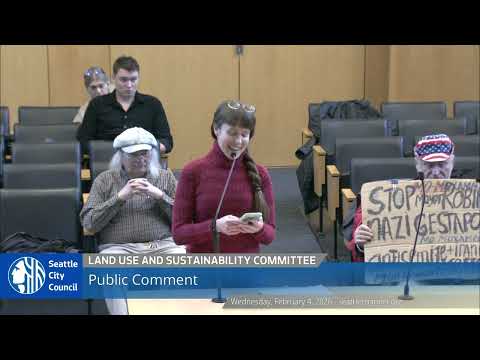
Land use committee advances SEPA-threshold changes, narrows parking exemption and tightens TMP rules
Summary
The Seattle City Council Land Use and Sustainability Committee on Feb. 4 recommended passage of two ordinances that raise categorical SEPA exemption thresholds and revise transportation management-plan and parking thresholds; amendments narrowed the parking exemption from 90 to 20 flexible-use stalls in most zones and linked TMPs to floor area and nonrequired parking.
The Seattle City Council Land Use and Sustainability Committee voted 4–0 on Feb. 4 to recommend passage of two ordinances that raise categorical SEPA (State Environmental Policy Act) exemption thresholds and update related transportation and cultural‑resource provisions.
The committee endorsed council bill 121093, the SEPA-threshold measure, and council bill 121135, which consolidates and refocuses requirements for transportation management plans (TMPs) and construction management plans. Chair Eddie Lynn moved the recommendation for CB 121093; Council member Rink seconded. Committee members recorded four votes in favor and none opposed; the recommendation for CB 121093 will be forwarded to the Feb. 10, 2026 City Council meeting. The committee also adopted a substitute and an amendment to CB 121135 and recommended that bill to the full council by unanimous committee vote.
Why it matters: Sponsors and SDCI staff said the changes align SEPA's categorical exemptions to growth already anticipated in the city’s comprehensive plan and reduce duplicative, project-level reviews that can delay housing production. SDCI policy director Dave Van Schaik told the committee that SEPA has evolved into a backstop while many environmental protections—stormwater, critical-area regulations, tree protections and shoreline rules—are codified in other codes and federal or state programs.
Key amendments: Council member Alexis Rink's Amendment 1 (version 3) to CB 121093 reduced the parking-trigger exemption for flexible-use (public/paid) parking from 90 stalls to 20 stalls in all zones except industrial and maritime, where the 90-stall threshold remains. The amendment also clarified parking definitions and added a warehouse clause to guide director discretion. The committee adopted the substitute to CB 121093 (which updates base code references to reflect the 1 Seattle comprehensive plan) and then adopted Amendment 1 v3 by roll call vote (4–0).
On CB 121135, the committee adopted a substitute bill and Amendment 1, which counts nonrequired accessory parking and floor area toward the TMP threshold for nonresidential uses so TMP obligations remain triggered for projects that add parking or gross floor area. Committee members described TMPs as a key regulatory tool to reach single‑occupancy‑vehicle reduction goals in the comprehensive plan.
Process and next steps: The committee package updates code maps and tables to reflect recent ordinances and state legislation referenced in the briefing materials (the staff presentation cited the state enactment codified as RCW 43 21 c 2 2 9 in the transcript). Both bills, as amended, were recommended to the full council; CB 121093 was set for the Feb. 10, 2026 council meeting. The committee recorded roll-call votes and will forward its recommendations and adopted amendments to the council for final action.
What staff said: SDCI staff emphasized that categorically exempting smaller, predictable infill projects can improve predictability for developers and avoid discretionary SEPA conditioning while preserving substantive protections that are enforced through other, specific codes. Staff also described proposed tribal-notification work—embedding state cultural-resource protocols in grading-plan requirements, designating a tribal engagement liaison in SDCI, and providing tailored permitting data access for tribal partners.
Vote at a glance: Committee recommendation to pass CB 121093 as amended — 4 votes in favor, 0 opposed; Committee recommendation to pass CB 121135 as amended — 4 votes in favor, 0 opposed.
The committee adjourned at 10:54 a.m.; both measures will now proceed to the City Council for consideration.