Get AI Briefings, Transcripts & Alerts on Local & National Government Meetings — Forever.
San Francisco health officials outline $17 million in CBO cuts as community warns of harms
Loading...
Summary
The San Francisco Department of Public Health presented a draft plan to realize $17 million in community-based organization funding reductions already included in the city budget and previewed further required savings; dozens of speakers urged the commission to preserve services such as HealthySteps, harm‑reduction training and HIV workforce programs.
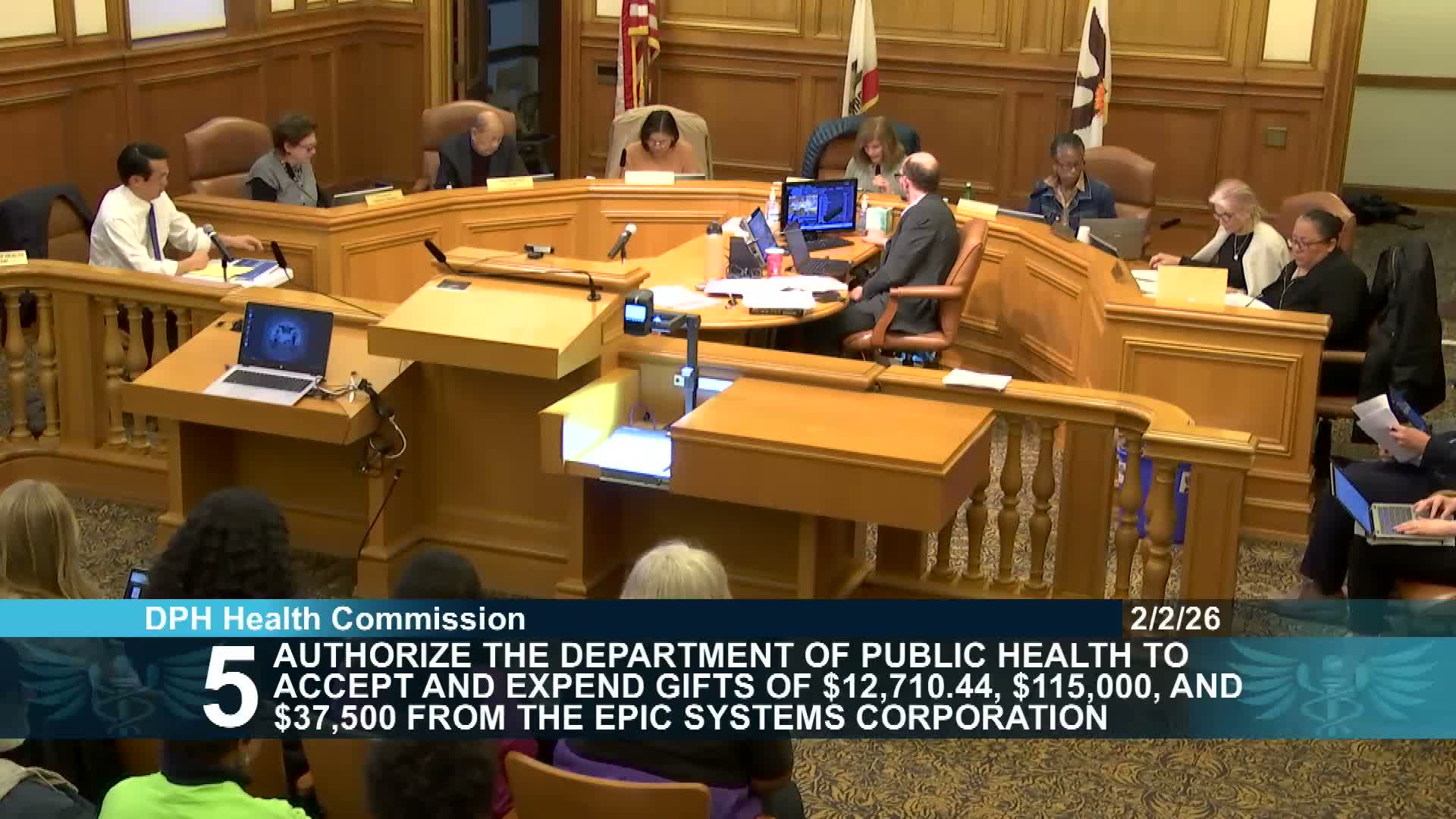
The San Francisco Department of Public Health on Monday detailed a plan to implement $17,000,000 in cuts to community‑based organization (CBO) contracts that appear in the city budget and outlined additional possible reductions the mayor’s office may request.
Director of Public Health Dr. [Tsai] told the commission the department prioritized preserving direct patient care while identifying non‑medical, capacity‑building and training programs for reductions. "Our guiding principle was not impacting direct patient and clinical services and care," Director Tsai said during the presentation.
The draft plan, posted in mid‑January and discussed at the meeting, targets roughly $6 million in reductions to workforce development and training contracts, about $5 million in affiliation‑agreement efficiencies (including changes to UC/UCSF funding tied to the HealthySteps pilot), and nearly $4 million in other program realignments. DPH staff said the $17 million has already been removed from the department’s baseline and the agency is proposing how to absorb those cuts without eliminating essential clinical services.
The proposal breaks the targeted reductions into categories that include: vocational supports and peer programs, internal staff capacity training, and administrative efficiencies. DPH Chief Financial Officer Drew (presenter name in transcript) described criteria used to evaluate programs—strategic fit, equity reach, cost‑efficiency, revenue potential and measurable population health outcomes—and the department’s intent to publish a final list by early March before a March 2 commission vote.
The budget briefing drew sustained public testimony. Dozens of clinicians, HealthySteps staff and pediatricians urged the commission not to abruptly end UCSF staffing for a HealthySteps program embedded in the Children's Health Center. "Transitioning HealthySteps at this time would be premature and would introduce real risk," Chen Chan, a HealthySteps co‑director, said, describing ongoing billing and claims work and pilots that staff argued need at least two more years to stabilize before a DPH absorption.
Community groups and program leaders from NAMI San Francisco, the San Francisco AIDS Foundation, Lyon‑Martin Community Health Services, the Harm Reduction Training Institute and many others testified that workforce training, peer‑led supports and culturally specific capacity building are central to preventing crises and reducing downstream hospitalizations and emergency costs. "These cuts are a choice," said Jamil Bailey, a client of the SF AIDS Foundation. "Stop looking at community‑based organizations as low‑hanging fruit."
DPH officials responded that the proposals focus on non‑medical, non‑leveraged CBO spending—programs that do not generate Medi‑Cal reimbursement—and that many direct care and disparity‑focused programs (for example, black maternal and infant health investments) are not part of these cuts. Director Tsai also said the department would continue to search for alternative funding or service models to preserve essential services where possible.
Commissioners asked staff to return with a clearer, program‑level impact analysis: what each proposed reduction would remove, what outcomes are at risk, and how DPH might mitigate harm. Several commissioners said they want the department to prioritize concrete impact assessments—how many clients would lose a service, what downstream costs could rise, and whether any program reductions would unlawfully reappropriate state‑mandated funds.
The department also cautioned that the $17 million is only the first tranche; the mayor’s office has asked departments to identify additional ongoing savings in the months ahead. DPH’s submission to the mayor is due Feb. 23, and staff said they expect further policy guidance and will run an eight‑week stakeholder process before returning to the commission with final recommendations.
Next procedural steps: public comment on the draft remains open through Feb. 4; DPH expects to publish a final list of the $17 million proposals by early March and to bring the wider FY2026–27 package—including any additional mayoral directives—back to the commission for formal action.