Lifetime Citizen Portal Access — AI Briefings, Alerts & Unlimited Follows
St. Petersburg Council votes 6–2 for 'plan‑first' approach to Historic Gas Plant District
Loading...
Summary
The City Council passed a nonbinding resolution asking the administration to complete a city‑led planning framework for the Historic Gas Plant District before selecting or advancing a developer; supporters said a master plan will protect descendants and public value, while opponents warned the pause could delay jobs and risk parcel‑by‑parcel sales.
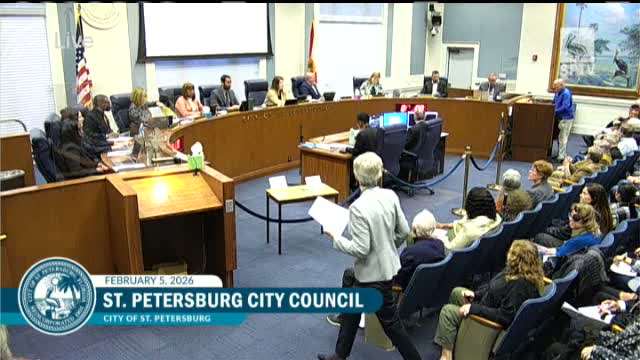
St. Petersburg City Council on Feb. 5 approved a nonbinding resolution asking city administration to pursue a planning‑first framework for the Historic Gas Plant District and to pause any selection, negotiation or advancement of a developer until that planning work is complete. The resolution passed 6–2, with Council Members Deborah Fick Sanders and Hopley Girdis voting no.
Council Member Brandy Gabbard (District 2), who introduced the resolution, said the measure was aimed at ensuring the city 'gets it right' for one of its largest remaining public assets and that the effort should center community stakeholders, descendants and clear guiding principles. "This is not about slowing down. This is about leveling up," Gabbard said, urging a professionalized, short planning engagement that could be completed in as little as six months.
Why it matters: The Gas Plant site—referred to in the record at times as an 82‑acre or an 86‑acre property—has drawn nine unsolicited proposals, but Gabbard and public speakers argued the city should own the master plan rather than have a profit‑seeking developer write it. Ron Diner, a resident who addressed council during public comment, warned that when "the City pays for the streets, the land value can exceed $1,000,000,000," and asked why the city would let developers decide street locations and phasing while the city would fund infrastructure.
Supporters pointed to the need for stronger oversight and community trust. Michael McGrath of Circle (Suncoast) urged a planning‑first approach that includes sustainability and green space, while members of the League of Women Voters told council the city lacks a council‑approved master plan for the Gas Plant District despite earlier planning studies.
Opponents and cautionary views: Several council members and speakers cautioned against indefinite pauses. Council Member Deborah Fick Sanders described fears among descendants of the site that a parcel‑by‑parcel sale could cause displacement and erase generational history. Other council members, including those who voted yes, stressed the two tracks—continuing proposers' engagement while completing a plan—should run in parallel so momentum and community input both continue.
Process and next steps: The resolution is nonbinding. Council members asked administration to bring a committee discussion on how a planning engagement would be structured and whether outside partners such as ULI Tampa Bay should be involved. Council members also asked for a date‑certain committee referral so the study and proposal reviews can proceed with council participation. Public commenters and some council members noted timing factors: the Rays are expected to play at the site for at least three more seasons, and one speaker said that fact gives the city time to plan.
Vote and formal action: The clerk announced the motion to adopt agenda item H‑2A passed 6 to 2. The motion as presented asked the city to 'pause the current proposal‑first process for the Gas Plant and instead move forward with a city‑led plan‑first approach' so that selection or negotiation with any developer would not occur ahead of a city‑led planning exercise.
What remains unresolved: The resolution does not direct a particular consultant or list a specific scope; it asks administration to work with council and stakeholders on a framework. Council members who supported the resolution said they expect a committee conversation soon; those opposed warned that without careful guardrails a plan‑first posture could be used to delay outcomes or lead to piecemeal disposals.
The council left open how the city will reconcile an array of existing studies and proposals and said more detailed committee work will follow. The resolution does not modify any existing contracts or cancel the city’s ongoing technical reviews of proposals.