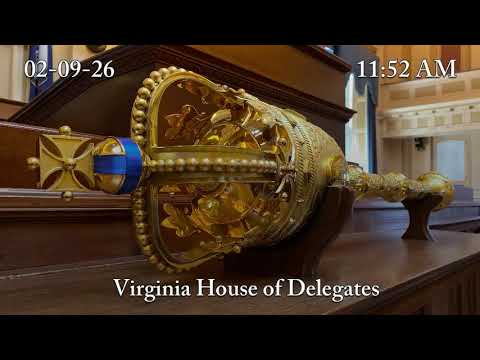
House engrosses caboose budget bill with redistricting amendment, sets April 21 referendum
Loading...
Summary
On Feb. 9, 2026, the Virginia House of Delegates engrossed and passed House Bill 29 — a revised biennial budget package — after adopting an amendment that places a temporary redistricting map before voters in an April 21 referendum; the recorded vote on the engrossed bill was 63–34.
RICHMOND — The Virginia House of Delegates voted on Feb. 9, 2026 to engross House Bill 29, the biennial “caboose” budget adjustment, and adopted an amendment that would implement a temporary redistricting plan contingent on a voter referendum scheduled for April 21, 2026.
Delegate Torrian, who presented the amendment package, said the set of changes includes tax-conformity language that the sponsors estimate will increase revenue by roughly $200 million and alters proposed employee bonuses from a 2% pay boost to a flat $1,500 payment for K–12 and state personnel. Torrian told the chamber the bonus change reduces higher-paid employees’ windfall while directing about $11.1 million in additional spending to ensure lower-paid workers receive a larger share. He described the net fiscal effect of the package as an approximately $4 million increase in spending offset by the revenue adjustments.
The amendment also revises the state’s election calendar — scheduling the 2026 primary for Aug. 4 — and includes language revising the 11th Congressional District. It preserved language restricting use of certain funds for abortion services except as required by state or federal law, per the text read into the record.
Why it matters: HB 29 bundles revenue and spending changes that affect multiple state programs and personnel categories while inserting high-salience political measures — most notably a temporary redistricting map that would only take effect if voters approve it in April. Supporters framed the referendum as the most public way to resolve a contested redistricting moment; opponents said the change circumvents normal constitutional or statutory safeguards.
Debate and challenge: Delegate Kilgore challenged the amendment’s procedural and constitutional basis on the House floor, saying, “I believe this is not constitutional,” and warning that the measure could conflict with requirements about intervening elections and how plans for congressional maps must be considered. Kilgore pressed that the change could retroactively affect earlier law and the conduct of future elections.
Supporters pushed back, including Delegate Price, who defended placing the question before voters as a public remedy to what some legislators characterized as a nationwide push to redraw maps for partisan advantage. Delegate Simon urged colleagues to “let the voters vote” on the question in April.
Recorded vote and next step: The clerk called a recorded vote on the engrossed bill; after the roll was closed, the bill was reported as engrossed and passed to its third reading by a roll call of 63 ayes and 34 noes. The House will consider final passage at third reading before the measure proceeds through the remainder of the legislative process.
What was in the bill: Sponsors explained the amendment package’s principal elements on the floor: a $200 million revenue adjustment tied to tax conformity; replacement of a proposed 2% bonus with a $1,500 per-employee bonus for K–12 staff and a corresponding change for state employees (savings elsewhere produced a net $4 million change); administrative timing changes for Department of Elections audit reporting; modifications to capital outlay language regarding DMV headquarters disposition; and an implementation of a temporary redistricting plan contingent on a voter-approved referendum.
The House adjourned after completing its calendar and set reconvening for noon on the following day.
Sources: Floor remarks and recorded votes (House calendar, Feb. 9, 2026).