Governor’s FY2027 education budget fully funds K–12 foundation; DEED projects small enrollment decline
Loading...
Summary
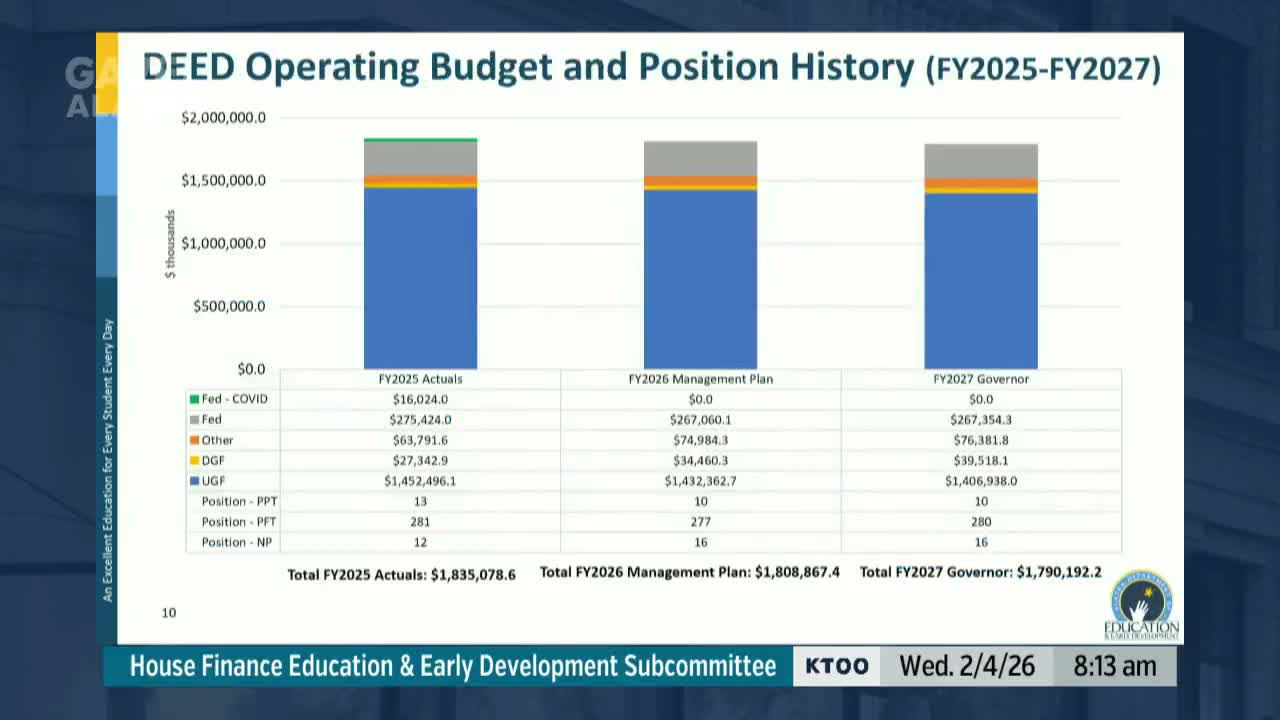
The governor’s FY2027 proposal totals roughly $1.79 billion for the Department of Education & Early Development, fully funding the K–12 foundation program and adding targeted increments for pupil transportation and a new residential program; lawmakers pressed DEED on vacancy rates, grant timeliness and a projected 1% enrollment drop.
The House Finance Education Subcommittee heard an overview Feb. 4 of the Department of Education and Early Development’s proposed fiscal 2027 budget, which Dawn Hannish, DEED administrative services director, summarized as "totals approximately $1,790,000,000." The proposal fully funds the K–12 foundation program, funds pupil transportation at $72,800,000, and includes smaller increments such as $467,000 from dividend raffle donations and $771,000 to launch a residential school program in the Lake and Peninsula School District.
Why it matters: The foundation program is the single largest component of the state education budget and is driven by average daily membership (ADM). DEED officials told lawmakers the proposed funding honors statutory formulas, but also warned of demographic and programmatic shifts that affect funding. Heather Heineken, DEED division director of finance and support services, said the department is projecting about a 1% decline in ADM from FY2026 to FY2027—approximately 1,500 students—driven in part by both brick‑and‑mortar and correspondence enrollment changes.
Key details and figures: Dawn Hannish presented the following figures from the governor’s proposal: approximately $1.79 billion total for DEED; roughly $1.27 billion to fully fund the K–12 foundation program; $72.8 million for pupil transportation; $467,000 from dividend raffle funds; and $771,000 to support a new residential program. Don Hanish said the Division of Administrative Services’ proposed funding is $6,204,000 and flagged a reduction in interagency authority where prior authority was unused.
Members’ questions focused on three budget pressures: the decline in Unrestricted General Fund (UGF) allocations noted in recent years, a reported 37 vacancies in DEED (about an 18.5% vacancy rate as of December 2025), and the department’s capacity to process grants and support districts. On grant timeliness, Commissioner Dina Bishop said the department’s goal is to get grants out within 30 days but acknowledged a delay with one competitive CLSD grant that stemmed from federal administrative transitions; DEED said it expects future entitlement grants to process on schedule.
What happens next: Members requested more granular data—10‑ and 5‑year staffing histories, a breakdown of the 37 vacancies and which are funded PCNs vs. unfunded, and deeper cost/KPI information to evaluate possible budget adjustments. The subcommittee scheduled follow‑up reviews, including a February 13th session to dive deeper into residential schools and a Feb. 6 continuation of the subcommittee work.
Ending: The subcommittee did not take votes on Feb. 4; members closed with requests for additional documentation and returned the presentation materials to staff for follow up.