Get Full Government Meeting Transcripts, Videos, & Alerts Forever!
Get email alerts on the Medicaid Rates topic
No spam. Unsubscribe anytime.
Home-care and assisted-living providers urge higher Medicaid rates to keep clients at home
Summary
Providers and association representatives told the Social Services Appropriations Subcommittee that longstanding Medicaid reimbursement rates for personal care, private-duty nursing and new-choice waiver-supported assisted living lag costs, forcing facilities to stop accepting waiver clients; speakers asked the committee to prioritize several RFAs to sustain in-home and assisted living care.
Home-care agencies, assisted-living operators and a statewide association told lawmakers Feb. 9 that Medicaid billing codes have not kept pace with inflation and workforce costs and that low reimbursement is forcing providers to limit or stop accepting waiver patients.
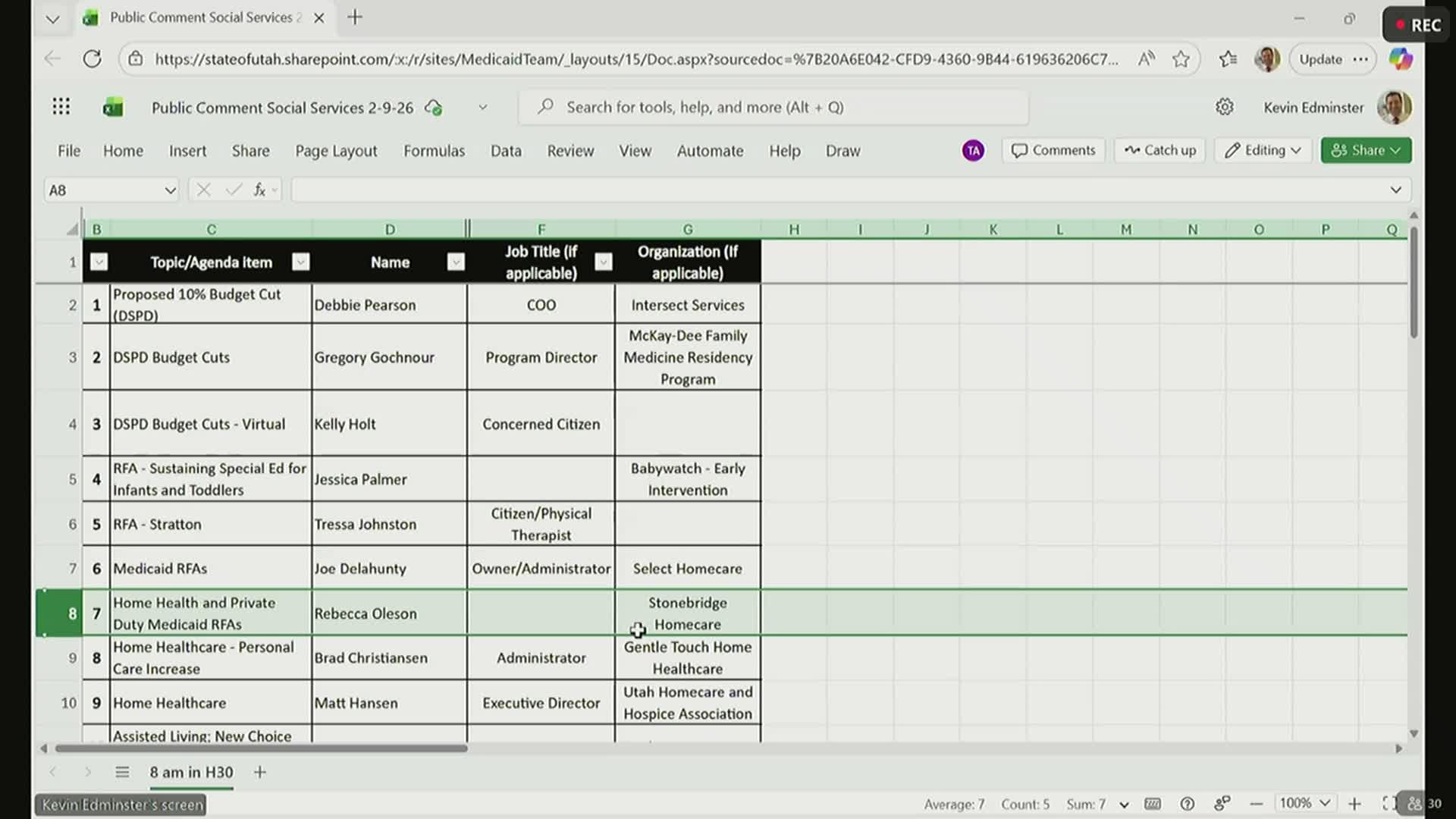
Rebecca Olson, executive director of Stonebridge Home Care, said her agency can't sustain providing services for aging-waiver and New Choices Waiver clients at current rates and asked the committee to approve a personal-care rate increase so agencies can continue 24/7 client supports.
Matt Hans (Home Care and Hospice Association of Utah) asked the committee to prioritize three RFAs: private-duty nursing for medically fragile children, skilled home health care, and personal-care services. He said billing codes have not seen meaningful increases for at least seven years while inflation has pushed provider costs up roughly 30%.
Scott Monson, who runs 16 assisted-living communities, said the New Choice Waiver daily Medicaid reimbursement (about $83 per day, by his account) is well below the typical cost to operate (he cited $120'$140 per day), which is motivating providers to exit the program and squeezing available assisted-living capacity. He warned that displacing residents to nursing facilities would raise Medicaid costs substantially.
Committee staff noted the three RFAs were included on the chair's recommended list; members said they would weigh those priorities as they finalize the lists to send to EAC.