
UVM Extension brief to Agriculture, Food Resiliency & Forestry committee highlights funding risks and launches statewide needs assessment
Get AI-powered insights, summaries, and transcripts
Subscribe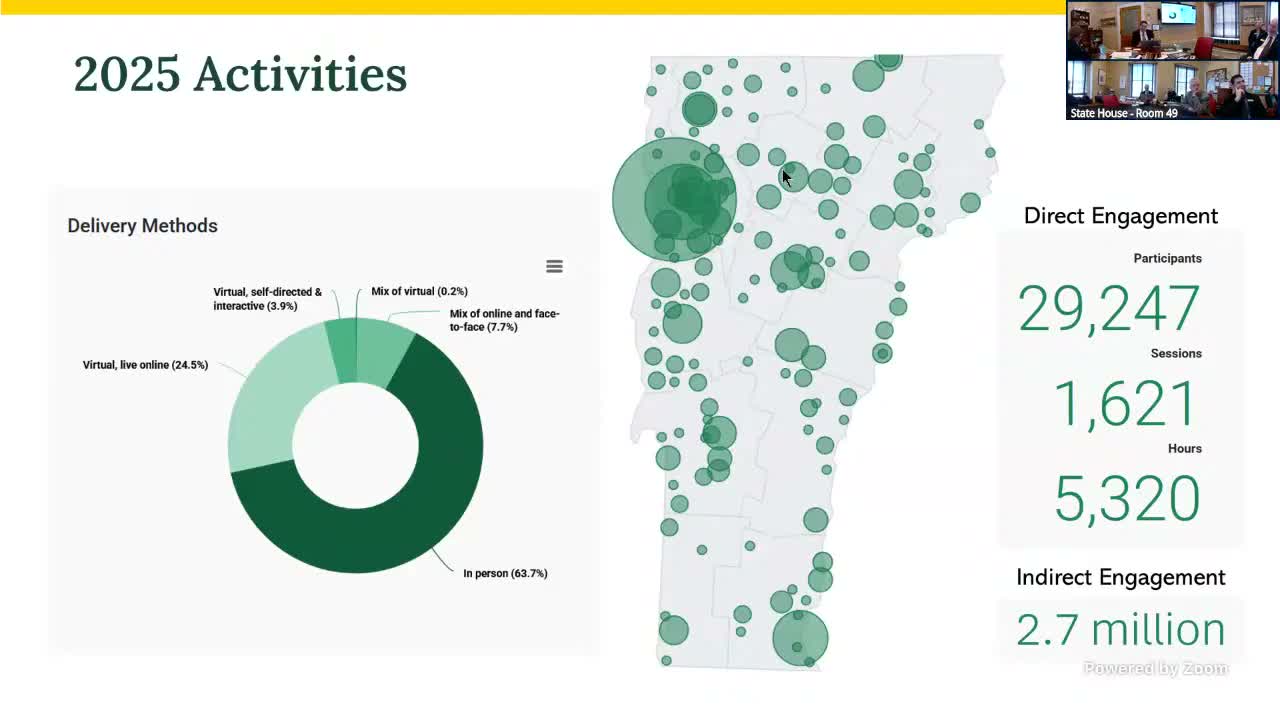
Summary
Chris, interim director of UVM Extension, told the committee that flat capacity funding, rising costs and shifting federal priorities threaten core programming; UVM Extension will lead a Vermont‑wide needs and assets assessment that will pair a large language model analysis with traditional literature review and local advisory committees.
Chris, interim director of extension and associate dean for extension at the University of Vermont College of Agriculture and Life Sciences, told the Agriculture, Food Resiliency & Forestry committee that UVM Extension remains a bridge between the university and communities but faces financial uncertainty.
"We engage with about 29,000 people a year directly," Chris said, and added that the extension’s materials and online resources reach “about 2,700,000 people annually” indirectly. He described extension’s four program areas—capable communities; healthy families (including 4‑H); the natural environment (forestry, Lake Champlain Sea Grant); and sustainable agriculture, food and forests—and noted field and research sites such as the Proctor Maple Research Center, Borderview Research Farm and the Miller Farm that help translate research into practice.
On funding, Chris described a mixed model of federal capacity funds (Smith‑Lever and Hatch/Experiment Station funds), state appropriations and competitive grants. He warned the committee that the president’s budget request had earlier proposed deep cuts—"zeroed out federal funding for the Ag Experiment Station and cut Smith‑Lever extension funding in half," he said—but noted that subsequent congressional appropriations had restored those lines for now. Chris stressed long‑term flat capacity funding, rising costs (for example, higher benefit rates) and new barriers in the competitive grant process that increase operational risk.
To better identify needs and assets across Vermont, Chris said Extension will lead a two‑pronged statewide assessment funded by the Land Institute for Rural Partnerships. The project will pair a large language model analysis of public documents and municipal records with a conventional literature review and then ground‑truth findings using two advisory committees—one of community participants and one of institutional representatives—to map gaps and connections between needs and available resources.
Chris asked the committee to consider the broader state appropriation context for UVM and noted that UVM’s recently released strategic plan presents an opportunity to align CALS and extension priorities with university pillars.
The session included follow‑up requests from committee members for a more detailed breakdown of competitive grant sources and clarification of the state appropriation figures. Chris said he would provide that information after the hearing.
The committee did not take formal action during the briefing; Chris said his materials and a white paper would be posted on the committee web site for further review.