Lifetime Citizen Portal Access — AI Briefings, Alerts & Unlimited Follows
Planning commission forwards Hopewell South PUD to council after accessibility debate
Loading...
Summary
The Bloomington Planning Commission voted to forward the Hopewell South Planned Unit Development — a roughly 6.3-acre rezoning of multiple West 1st Street parcels — to the Common Council with conditions after lengthy discussion about affordability, accessibility and technical ordinance edits.
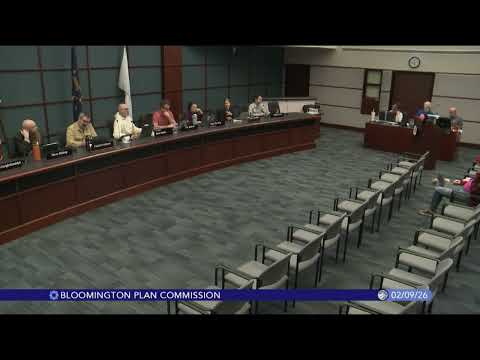
The Bloomington Planning Commission on Feb. 9 voted to forward a petition from the City of Bloomington Redevelopment Commission to rezone parcels at 723, 709 and 607 West 1st Street into a Planned Unit Development known as Hopewell South, asking the Common Council to consider the PUD with staff-recommended conditions and additional accessibility and text-cleanup requirements.
The petition covers about 6.3 acres and would replace former hospital and convalescent uses with a unified plan that, in the petitioner’s materials, would yield roughly 98 homes across a mix of single-family, small-multifamily and accessory dwelling units. The petitioner and staff said the PUD allows several departures from the Unified Development Ordinance — including narrow 20-foot “lanes,” lots that do not front a public street and 0-foot setbacks on many interior lots — that together enable a denser, lower-average-cost product. The petitioner said its modeling reduces an average unit cost from about $425,000 (by-right scenario) to about $270,000 (PUD scenario).
Why it mattered: commissioners, staff and dozens of public commenters focused on how the project balances affordability, design innovation and accessibility. City staff recommended forwarding the PUD with conditions; residents and disability advocates urged stronger, binding protections for visitability and wheelchair accessibility in the preapproved housing catalog. The commission added conditions requiring documentation of how accessibility and engagement with people with disabilities will be evaluated, and directed the petitioner to work with staff to correct citation and clarity errors in the PUD text before it goes to council.
Staff and petitioner presentation
Planning staff summarized the PUD request and technical justifications: the parcels lie in a Transform and Redevelopment Opportunity overlay, the PUD would allow a coordinated pedestrian network and stormwater plan, and several cross-sections (Jackson and Fairview) are proposed narrower than typical city standards to enable more buildable area. Staff also outlined a phased buildout: Phase 1 at the west, Phase 2 center, and Phase 3 at the east, which includes the former convalescent building.
Ali, representing the Redevelopment Commission, described the housing catalog of preapproved home designs intended to speed permitting and lower costs, local-builder training partnerships, and a “blended-income” approach. The petitioner committed in the PUD to affordability thresholds: the petition text states at least 50% of total dwelling units (by dwelling area) would be affordable to buyers at or below 100% of area median income (AMI), and at least 15 dwelling units would be permanently income-limited to households earning less than 120% of AMI. The petitioner also described specific accessibility targets, saying about 29% of the units would meet either full ADA or Fair Housing Act (FHA) standards.
Accessibility, visitability and legal treatment of affordability
Public comment was dominated by disability-accessibility concerns. Susan Sizer, co‑president of the Mobility Aids Lending Library, and Karen Millison of the Council for Community Accessibility urged that new homes be built with step-free (“visitable”) entrances and usable bathrooms so residents and visitors who use wheelchairs are not forced to retrofit. Millison told the commission she supports the PUD “but I’m asking you to approve it with the caveat and condition that people with disabilities must be involved in the process going forward.” Leslie Davis and others asked that the city require ongoing reporting and engagement with disability advocates as plans proceed.
Commissioners and staff debated whether the PUD must use deed restrictions to secure long-term affordability. Commissioner Holmes read qualifying standards in the UDO and asked whether future changes to the UDO or city policy could alter the PUD’s commitments. Legal staff (Dana Kerr) said deed restrictions and zoning commitments are recorded instruments that bind future owners unless the city releases them; staff also noted the PUD text lists multiple mechanisms (forgivable seconds, silent seconds, rights of first refusal) that the Redevelopment Commission could use to meet affordability standards without relying solely on deed restrictions.
Parking, lanes and fire access
The petitioner explained the 20-foot lanes are being designed as public fire-access routes with 2×9-foot travel lanes and concrete ribbons to satisfy fire code; those lanes are not intended to allow unrestricted parking that would block emergency access. The PUD language on “on-street parking” in lanes was flagged as confusing; the petitioner and staff agreed to revise language to clarify that designated parking spaces will be built and that lanes will be signed and enforced as fire lanes.
Commission action and conditions
Commissioner Ballard moved to forward the PUD to the Common Council with a favorable recommendation, subject to the nine conditions in the staff packet plus an added 10th condition requiring the petitioner to include in the project record written documentation describing how visibility and accessibility were evaluated and how people with disabilities were engaged prior to approval of any primary plat or final plan. Commissioners also approved an 11th condition directing staff, the petitioner and Commissioner Stossberg to correct citations and clarify ordinance language in the PUD text before it goes to council. The motion carried on roll call.
What’s next
The commission’s action sends the PUD and the appended conditions to the Common Council for legislative review. Staff will work with the petitioner to clean up ordinance citations and to finalize the accessibility-engagement documentation before council consideration. The commission closed the meeting and scheduled its next monthly meeting.
Quotes
“Deed restrictions are poison pills for getting houses developed, because you can’t resell them,” Mayor Carrie Thompson said during the hearing, urging the commission and staff to consider alternatives to strict deed restrictions while preserving affordability goals.
“We’re committing to the percentages that will be done — a larger percentage for first sale, a smaller percentage that is permanently protected,” the petitioner said, summarizing the RDC’s approach to meeting PUD affordability standards.
Ending
The Planning Commission’s vote does not adopt the PUD; it forwards a recommendation and conditions to the Common Council, which will make the final legislative decision. Staff said they will return documentation of accessibility engagement and corrected ordinance language with the PUD when it is scheduled for council review.