Get Full Government Meeting Transcripts, Videos, & Alerts Forever!
Get email alerts on the Environment topic
No spam. Unsubscribe anytime.
State-led grant aims to replace water-softening systems in "Vineyards" area; town seeks additional funds
Summary
CT DEEP is administering a $50,000 program to address elevated sodium and chloride levels in wells in the Vineyards area; the town and state representative are seeking an additional $100,000 to expand the program and replace or upgrade residents' water-softening systems and dry wells.
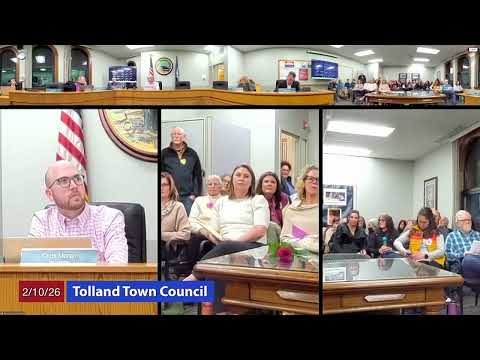
Town staff told the Tolland Town Council on Feb. 10 that Connecticut Department of Energy and Environmental Protection (DEEP) is administering a grant program to address contaminated wells in the Vineyards neighborhood and that town consultants and health officials are coordinating participation.
Mike Wilkinson (town staff) said DEEP's program would help residents replace or upgrade water-softening systems and remediate dry wells in priority locations, and that the initial DEEP grant for the Vineyards was $50,000. The town has sought additional funding—an effort supported by Representative Riccio and local legislators—to add roughly $100,000 to the effort.
Wilkinson said five locations in the Vineyards show sodium and chloride levels above acceptable thresholds; the program uses a combination of DEEP funding and resident cost-sharing in some cases, and the town-hired consultant Langan has completed site assessments and recommended remedies. The stated goal is to replace as many as 15 systems to reduce contamination across the cluster and achieve economies of scale on well and system work.
Town staff noted some single homeowner remediation efforts have already improved neighboring wells; in one example turning off a private water-softening system reduced nearby contamination. The town will continue to coordinate with DEEP, Eastern Highlands Health District and consultants to prioritize sites, identify residents willing to participate and pursue additional state funding.
Why it matters: Contaminated wells affect potable-water safety and household plumbing; targeted remediation and funding can reduce health risks and household costs for affected residents.
What happens next: DEEP will continue to administer enrollment and technical work; the town is seeking additional funds and will keep residents informed about eligibility and next steps.
Provenance: topicintro SEG 3290; topfinish SEG 3460.