Get Full Government Meeting Transcripts, Videos, & Alerts Forever!
Get email alerts on the Menopause Care topic
No spam. Unsubscribe anytime.
Joint committee hears broad support for bill to expand perimenopause and menopause care in Massachusetts
Summary
Supporters including clinicians, advocates and insurers told a joint public‑health committee that House Bill 4,838 would close treatment, training and workplace gaps for perimenopausal and menopausal people; the committee took testimony and left the record open for written comments.
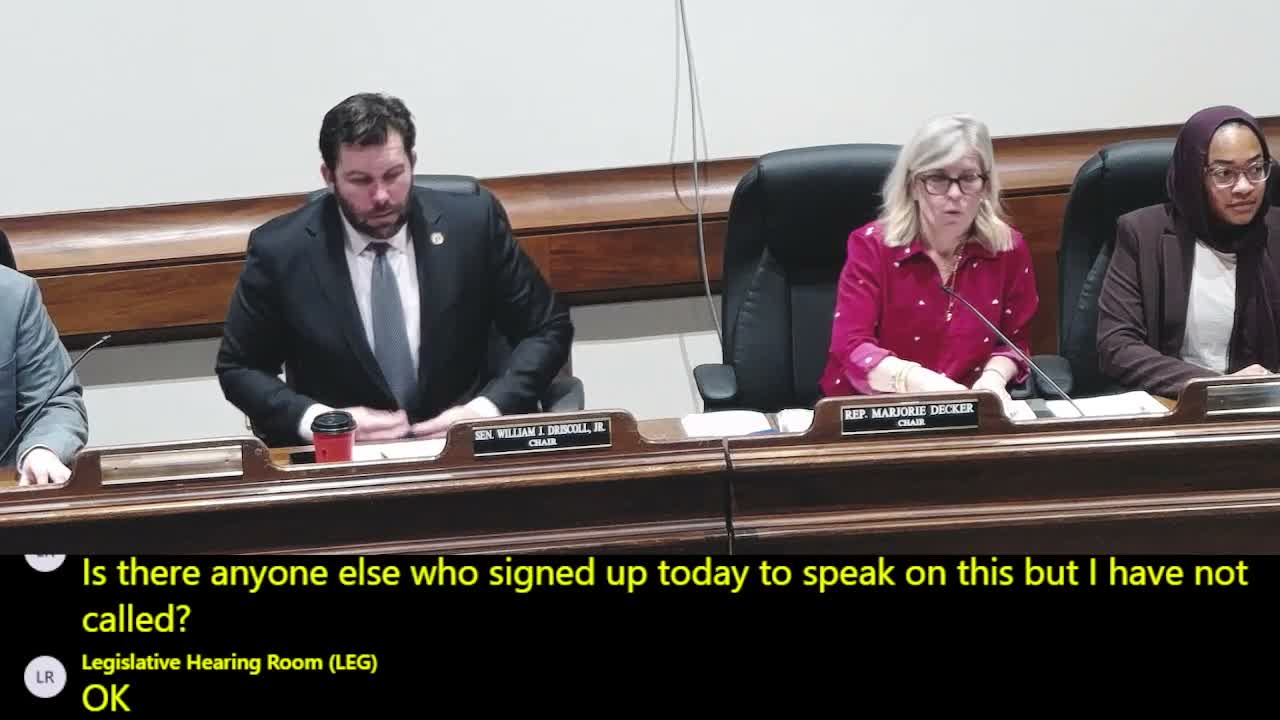
Representative Decker and Senate Co‑Chair Senator Driscoll convened the Joint Committee on Public Health on Feb. 12 to take testimony on House Bill 4,838, legislation that would expand access to perimenopause and menopause care across Massachusetts.
The bill, which Representative Decker described as "a starting point," would create a stakeholder commission, require evidence‑based clinician education, direct the Department of Public Health to disseminate public information, and strengthen workplace protections and access to treatments. "This bill will not be the bill that comes out of committee. This is a starting point," Decker said, inviting input from clinicians, advocates and patients.
A string of witnesses described delayed diagnosis, misdiagnosis and limited clinician training as recurring problems. Andrea Giannkantieri, founder and CEO of Whiney Guiney LLC, said, "Menopause care in Massachusetts is still too dependent on luck," and urged clearer access pathways, cross‑specialty training and accountability. Paula Brown of Konenki Menopause Solutions recounted six years of misdiagnosis that led to lost income and inappropriate medicines. Dr. Liza Swadowski, a Boston gynecologist with community health‑center experience, urged the committee to ensure the bill’s education requirements are substantive rather than token training.
Clinical and public‑health experts pressed the workforce and long‑term health rationale for the bill. Dr. Jan Shifron of Mass General and Claire Gill of the Bone Health and Osteoporosis Foundation warned that untreated menopausal symptoms and estrogen deficiency can raise risks of cardiovascular disease, fractures and other chronic conditions. Dr. Deborah Kwolek (Harvard Medical School) urged required, meaningful continuing medical education in menopause care rather than a single superficial hour of CME.
Advocates framed the bill as an equity and workforce issue. Dr. Ndidi Amaka Mutanukaga of the Tufts Center for Black Maternal Health and Reproductive Justice said the burdens of symptom delay and limited access fall disproportionately on Black and other historically marginalized women. Workplace and economic impacts were highlighted by witnesses including Shannon Hansen, who said she paid "over $1,200 a year" out of pocket for medication and that untreated symptoms contributed to leaving a job.
Paul Jones, director of legislation and policy for Blue Cross Blue Shield of Massachusetts, said his insurer supports the bill’s training and workplace elements and described existing coverage that includes primary care, gynecology, mental‑health care and "hormone replacement therapy with no prior authorization required." He also explained Blue Cross’s recent decision to limit coverage for certain GLP‑1 obesity drugs, attributing that policy to unsustainable premium impacts and rebate‑contract constraints.
Committee leaders closed the hearing without taking a vote and invited additional written testimony and follow‑up briefing sessions. The committee record remains open as staff and members consider the stakeholder feedback and technical drafting needed to refine H.4838.