Get Full Government Meeting Transcripts, Videos, & Alerts Forever!
Get email alerts on the Sea Level Rise topic
No spam. Unsubscribe anytime.
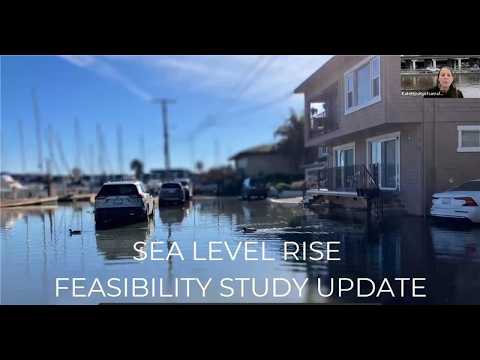
San Rafael presents three adaptation paths to address rising tides; study estimates up to $1.8 billion for most transformative option
Summary
City of San Rafael staff and consultants presented a feasibility study showing three broad adaptation approaches—raised edges, a canal gate with a large pump station, and incremental elevation/redevelopment—each with trade-offs in cost, timelines, displacement risk and environmental impacts; study leaders urged community input and noted pumps and ownership are central constraints.
San Rafael officials and their consultants laid out three distinct strategies to reduce flooding and overtopping risks in the city’s low-lying basin during a public webinar: raising continuous shoreline edges, installing an operable canal gate with a large forward pump, or pursuing long‑term incremental elevation and redevelopment that would reconfigure land along the canal.
The study team, led by project manager Andy Sternad of Wagner and Ball, emphasized that the community is already seeing “tipping points” where king tides and storm surge overtop informal shorelines. “These are tipping points, we’re already seeing these overtopping impacts,” Sternad said during the presentation, noting recent observed tides of about 8.37 feet in 2024 and an earlier-month tide near 8.7 feet.
Why it matters: thousands of residents and essential facilities lie on land already below high-tide elevations. The team estimated that roughly 16,000 people live in the area vulnerable to bay and canal flooding and modeled a sharp rise in impacts once water levels reach the 8–9 foot range—a threshold that would make previously rare events much more frequent.
What the alternatives would do: the raised‑edge option (Alternative 1) focuses on constructing continuous levees, seawalls and raised roads to protect existing structures in place; it is generally faster to implement but provides fewer co‑benefits such as added public access. The canal‑gate option (Alternative 2) would install a navigable gate at the mouth of the canal paired with bayfront lifts and a forward pump station; Sternad said the forward pump would be “approximately 3,000 CFS,” roughly an order of magnitude larger than San Rafael’s largest current pump, and that adaptations behind the gate would still be required. The incremental elevation and redevelopment option (Alternative 3) would create new space for shoreline infrastructure and habitat but would touch the most properties, likely take the longest (studied estimates in the presentation ranged around 20–40 years), and present the highest near‑term displacement risk.
Costs and operations: the presentation compared first costs and years of construction. Sternad said the gate option appeared to have the lowest initial capital cost when only its unique elements were counted, but he cautioned that downstream mitigation and behind‑gate adaptations could substantially increase the total. The slide deck showed a rough high‑level cost for the most transformative redevelopment alternative of about 1,800,000,000.0 (presented as a rough, order‑of‑magnitude figure), and the team noted that all options would likely require state or federal grants plus a local contribution.
Trade‑offs: each alternative carries distinct permitting, ownership and ecological consequences. Raised edges and the gate generally preserve current shoreline ownership patterns unless the city acquires easements or parcels; large in‑water structures may require mitigation for habitat impacts and coordination with regulatory agencies including BCDC and the U.S. Army Corps of Engineers. By contrast, the redevelopment option could expand habitat, extend the Bay Trail and create other co‑benefits but would require acquiring or reconfiguring land and rebuilding structures.
Operational constraints: the consultants underscored that existing pump infrastructure is sized for stormwater, not prolonged bay overtopping or saltwater flows. “If you’re in a bathtub, you need an edge to pump over it to get the water out,” Sternad said, describing why pumps alone cannot replace a raised edge or other physical barrier.
Community process and next steps: project staff urged continued public engagement—more than 145 outreach events and recorded resources to date—and encouraged residents to take a posted survey. Kate Hageman, who leads the city’s work, said the presentation would be repeated in Spanish that evening (in person at the wellness center on Koerner and online via Canal Alliance’s Facebook Live) and that the city would integrate recommendations into planning work, pursue a regional shoreline adaptation plan, and continue technical and community working groups.
What remains unresolved: the study intentionally presented alternatives for public review rather than recommending one path. The consultants flagged uncertainties about long‑term pump operations, the frequency with which a gate might have to close under different sea‑level scenarios, the logistics and cost of land acquisition or easements, and the full downstream mitigation that could follow a gate installation. Funding strategies and precise cost allocations among local, state and federal partners were not specified and will be subject to future planning and grant efforts.
Next procedural step: the study materials and a survey are on the city’s adaptation web page and the team plans further community outreach and formal planning (including an East San Rafael specific plan and a regional shoreline adaptation plan).
Speakers quoted in this report are limited to those who spoke on the record during the webinar: Micah Jorens Gulati (City Councilmember, District 1), Kate Hageman (City of San Rafael project lead), and Andy Sternad (principal, Wagner and Ball; project manager for the consultant team).