Get AI Briefings, Transcripts & Alerts on Local & National Government Meetings — Forever.
House committee advances Senate Bill 37, sponsors say amendments protect bilingual and indigenous instruction
Loading...
Summary
The House Education Committee voted 12–0 to give Senate Bill 37 a do-pass after adopting sponsor-written amendments that emphasize evidence-based biliteracy practices, require K–3 screening, and mandate at least four written parent progress reports per year. Supporters said the changes protect bilingual and indigenous-language instruction; some tribal leaders said further work is needed.
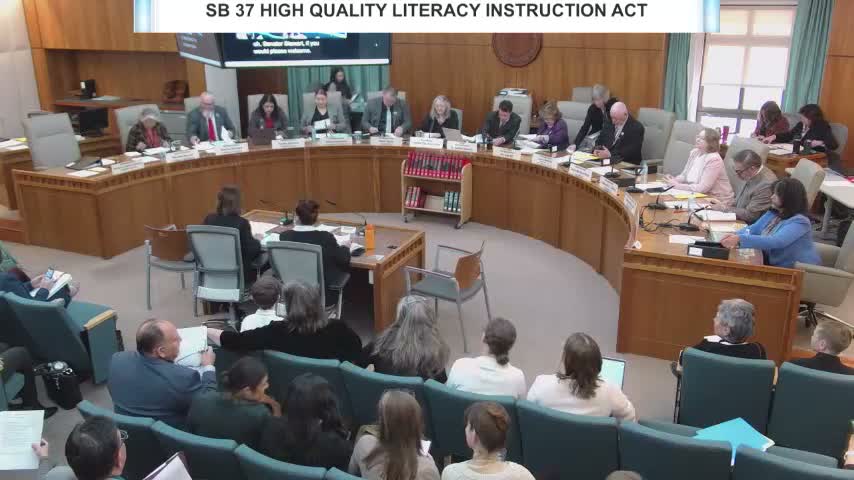
Senator Stewart told the House Education Committee that Senate Bill 37, the High Quality Literacy Instruction Act, would require preservice educators and K–3 reading instruction to align with structured, evidence-based literacy practices while protecting bilingual and indigenous-language instruction. “The bill before you right now, Senate Bill 37, was endorsed by our LESC,” Stewart said, framing the measure as built with PED and local stakeholders.
The legislation requires reading instruction for kindergarten through third grade and reading interventions through 12th grade to use high-quality instructional materials approved by the Public Education Department and asks PED to adopt a short K–3 formative reading assessment that is “minimally disruptive” and tied to instructional support. Sponsors and PED witnesses repeatedly emphasized that structured literacy applies to any alphabetic language and that the amendments include language to support biliteracy, American Sign Language and indigenous languages.
Jackie Castellas of PED described the state’s materials review process and how teachers may use supplemental materials when core curricula do not meet students’ needs. “Strong readers grow from strong language foundations,” Castellas said, arguing that the bill’s provisions protect rather than supplant bilingual programs and that the PED list is created by New Mexico teachers and is published as required by statute.
Supporters included classroom teachers, school districts, the New Mexico School Superintendents Association and tribal leaders. A third-grade student, Riley Gaffney, described personal gains after receiving explicit reading instruction and urged a yes vote. Disability Rights New Mexico and other organizations highlighted commitments to identifying dyslexia and training for literacy coaches.
Speakers from Pueblo of Acoma and Taos Pueblo urged more substantial changes, arguing the bill risks favoring English-dominant approaches and could undermine existing protections under the Indian Education Act and bilingual/multicultural statutes. Davey Maly of Pueblo of Acoma said tribal communities need guaranteed resources for language coaches, curricula and materials tailored to indigenous languages.
Committee members pressed sponsors and PED on costs and implementation. PED officials said instructional-material purchases are funded through the public school funding formula (noting roughly $55 million in HB2 this year for instructional materials), that roughly half of elementary schools already have HQIM, and that the state currently supports literacy coaching through existing funds (PED cited 72 coaches at a roughly $9 million annual cost line). PED also cited a $30 million annual investment in Native language and culture programs.
The committee adopted the sponsor’s amendment (moved by Representative Bahta and seconded by Representative Garrett) and then voted 12–0 to give Senate Bill 37 a do-pass as amended. The committee’s action forwards the amended bill to the House floor for further consideration.
What’s next: SB37 will be scheduled on the House floor calendar for further debate and a floor vote; committee members said they may continue interim work on workload and implementation issues.