Get Full Government Meeting Transcripts, Videos, & Alerts Forever!
Mesa outlines backup water supplies and costly options if Colorado River cuts materialize
Summary
City staff told the Mesa City Council on Feb. 12 that the city currently meets demand through a diversified portfolio (SRP on-project supplies, CAP allocations, tribal exchanges, groundwater and long-term storage credits) but warned that draft federal cuts to Colorado River allocations could force use of expensive projects such as Bartlett Dam expansion and advanced water purification.
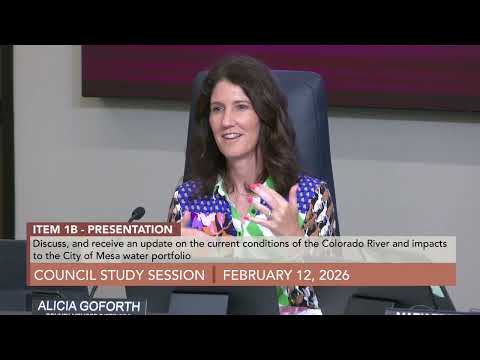
Mesa city staff briefed the City Council in a Feb. 12 study session on the city's water portfolio, explaining how current supplies would cover near-term demand and what projects and costs the city could face if federal changes to Colorado River operating rules reduce Central Arizona Project (CAP) deliveries.
The presentation, led by city water staff, said the 2007 20-year operating guidelines for the Colorado River expire this year and a draft environmental impact statement released under NEPA contains alternatives that include significant CAP reductions. "None of the alternatives in the draft bode very well for Arizona," staff said, urging the council to expect cuts and to comment on the draft EIS (the comment period was noted to end March 2).
Why it matters: Mesa relies on a mix of water types that respond differently to cuts. The city zone served by Salt River Project (SRP) surface water has ample headroom (staff cited about 62,000 acre-feet available versus roughly 33,000—6,000 acre-feet demand in that zone). The eastern and southern zones depend on CAP water and associated agreements; staff reported about 43,500 acre-feet of municipal and industrial CAP entitlement for Mesa and total Colorado-River-related availability including tribal leases of just over 53,000 acre-feet. Current organic demand in CAP service areas is roughly 58,000 acre-feet.
Mesa's lower-cost supplement is an exchange with the Gila River Indian Community (GRIC).…
Already have an account? Log in
Subscribe to keep reading
Unlock the rest of this article — and every article on Citizen Portal.
- Unlimited articles
- AI-powered breakdowns of topics, speakers, decisions, and budgets
- Instant alerts when your location has a new meeting
- Follow topics and more locations
- 1,000 AI Insights / month, plus AI Chat