Get Full Government Meeting Transcripts, Videos, & Alerts Forever!
Get email alerts on the Water Supply topic
No spam. Unsubscribe anytime.
Mesa outlines backup water supplies and costly options if Colorado River cuts materialize
Summary
City staff told the Mesa City Council on Feb. 12 that the city currently meets demand through a diversified portfolio (SRP on-project supplies, CAP allocations, tribal exchanges, groundwater and long-term storage credits) but warned that draft federal cuts to Colorado River allocations could force use of expensive projects such as Bartlett Dam expansion and advanced water purification.
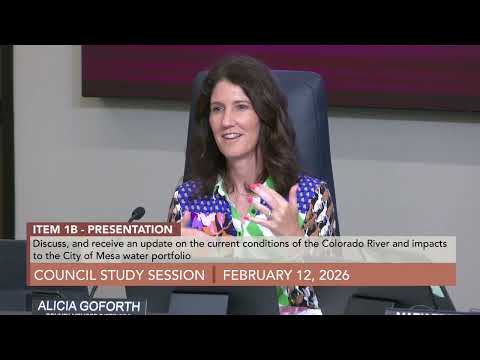
Mesa city staff briefed the City Council in a Feb. 12 study session on the city's water portfolio, explaining how current supplies would cover near-term demand and what projects and costs the city could face if federal changes to Colorado River operating rules reduce Central Arizona Project (CAP) deliveries.
The presentation, led by city water staff, said the 2007 20-year operating guidelines for the Colorado River expire this year and a draft environmental impact statement released under NEPA contains alternatives that include significant CAP reductions. "None of the alternatives in the draft bode very well for Arizona," staff said, urging the council to expect cuts and to comment on the draft EIS (the comment period was noted to end March 2).
Why it matters: Mesa relies on a mix of water types that respond differently to cuts. The city zone served by Salt River Project (SRP) surface water has ample headroom (staff cited about 62,000 acre-feet available versus roughly 33,000—6,000 acre-feet demand in that zone). The eastern and southern zones depend on CAP water and associated agreements; staff reported about 43,500 acre-feet of municipal and industrial CAP entitlement for Mesa and total Colorado-River-related availability including tribal leases of just over 53,000 acre-feet. Current organic demand in CAP service areas is roughly 58,000 acre-feet.
Mesa's lower-cost supplement is an exchange with the Gila River Indian Community (GRIC). Under the exchange Mesa delivers reclaimed water and receives Colorado River water on a 5:4 ratio; staff said Mesa currently receives about 8,000 acre-feet a year through the exchange but the reuse pipeline will move that toward 16,000—17,000 acre-feet and the contract allows for larger volumes (up to about 23,520 acre-feet under full exercise). Staff highlighted a stark price difference this year: pumping charge for exchange water roughly $85 per acre-foot versus CAP municipal & industrial water about $365 per acre-foot.
Staff also reviewed backup resources: New Conservation Space (NCS) created by the Roosevelt Dam raise provides 41,000 acre-feet of flood-storage credits (staff said roughly 30,000 acre-feet are currently unused in Mesa's account and the state treats that as approximately 12,500 acre-feet/year of sustainable supply in 100-year accounting). Long-term storage credits (LTSC) total about 557,000 acre-feet across various storage facilities, which staff said equates to roughly 10 years of current CAP-era demand for the Colorado River service areas if fully drawn down. Groundwater resources and incidental recharge provide an additional roughly 10,000 acre-feet per year of sustainable yield under state calculations.
Modeled cut scenarios: Staff walked council through a 20% CAP municipal & industrial cut scenario from the draft EIS and said Mesa could meet moderate projected demand in the near term using NCS, groundwater allowance and LTSC. Staff warned that deeper or sustained cuts would require Mesa to accelerate costly projects (examples discussed included Bartlett Dam storage expansion, additional well drilling and equipping, and advanced purified water projects) or to pursue greater reclaimed-water production through septic-to-sewer conversions.
On potential additions and timing: Bartlett expansion is expected to provide a stakeholder allocation that staff estimated could translate to roughly 10—13,000 acre-feet before adjustment but, when state conversion factors are applied, might add about 3,000 acre-feet/year in assured-supply accounting. The city's central reuse pipeline is scheduled to come online imminently and will materially increase exchange volumes for 2028 orders. Advanced purification at the 91st Avenue reclamation facility is at feasibility stage; staff said such a project is an 8—10-year horizon and carries a high price tag, although federal participation could change the financial outlook.
Demand-management options and conservation: Staff emphasized tools available through Mesa's water shortage plan. City Manager Chris Brady (referenced during the presentation) earlier declared a Stage 1 water watch in 2022; staff explained that higher stages with mandatory measures would be presented to council for approval and that triggers for escalation tie to supply shortages and modeled CAP cuts.
Assured water supply and permitting: Staff advised the council that Mesa submitted its assured water supply application to the Arizona Department of Water Resources (ADWR) in October 2023 and that ADWR extended Mesa's current designation pending review. Council members expressed concern about the time the application has been pending.
Costs and capital: Staff gave example costs for wells (recent equipping bids and drilling put a single well's full cost in the mid-single to low-seven-figure range, roughly $6—7 million each in combined drilling and equipping estimates) and said multiple wells are planned to expand the city's well fields in Southeast Mesa. Smart metering, leak detection and septic-to-sewer conversions were described as lower-cost, incremental steps that increase reclaimed-water supply and reduce lost water.
Council reaction and next steps: Councilmembers thanked retiring water department staff for their service and pressed staff on timing, triggers for stages and financing for future projects. Staff urged continued engagement with the draft EIS process, said the city will pursue regional partnerships and legislative engagement as needed, and noted that future Council consideration will be required for major capital actions and any mandatory shortage-stage measures.
The study session concluded after a brief procedural motion (acknowledging receipt of board minutes, approved by voice vote) and adjournment. The city will continue to brief council as negotiations and federal rulemaking proceed.