Get Full Government Meeting Transcripts, Videos, & Alerts Forever!
Get email alerts on the Sips Funding topic
No spam. Unsubscribe anytime.
SBCSA emphasizes funding rules, fiscal coordination and evidence-based strategies for SIPs
Summary
In a training session, SBCSA's Brittany Weinhold urged charter schools to involve fiscal staff, follow the supplement‑not‑supplant rules for federal grants, and choose evidence-based interventions aligned to ESSA tiers when building improvement strategies for 2026–27 school improvement plans.
Brittany Weinhold, education programs professional on the SBCSA school support team, highlighted three funding considerations schools must account for when drafting their 2026–27 school improvement plans: federal funds’ allowable uses, the supplement‑not‑supplant rule, and the need to involve fiscal staff to ensure alignment between SIP entries and grant-management systems.
Weinhold said federal funds can be used to fill gaps or provide additive services (for example stipends or extra training) but cautioned that federal dollars have individual tracking and compliance requirements. She noted ESSER COVID‑relief funds did not carry the same supplement‑not‑supplant requirement, whereas Title programs (Title I A, Title II A, Title III EL, Title IV A) and IDEA funds are subject to supplement‑not‑supplant analysis.
Fiscal coordination and platform requirements
Weinhold urged schools to include fiscal or contracted staff in SIP development because those staff typically know federal grant allowability, maintenance-of-effort and comparability requirements. She said the fund-sourcing information entered in the SIP must replicate the requested budget details entered in the SBCSA grant-management system.
Evidence-based strategies
Every improvement strategy listed in the SIP must be supported by an evidence-based intervention (EBI) aligned to ESSA tiers. Weinhold described the tiers: Level 1 (strong, randomized controlled trials), Level 2 (moderate, quasi-experimental), Level 3 (promising, correlational evidence with controls) and Level 4 (rationale or research‑based theory). She recommended privileging higher-tier strategies but said Level 4 strategies are acceptable if they are well rationalized and closely monitored.
Practical implications
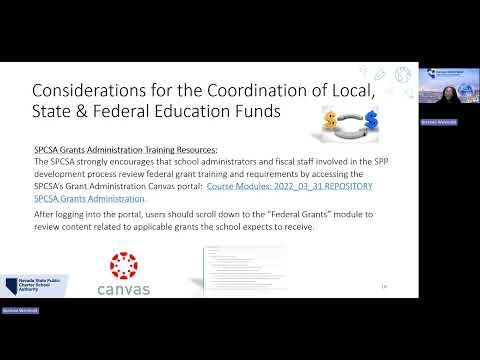
Weinhold advised schools to consider sustainability when federal grant funds expire and to determine how program activities would be funded if federal funds were not available. She also recommended consulting the SBCSA grants team and the SBCSA Canvas portal for federal grant training resources to ensure compliance and avoid plan rejection.