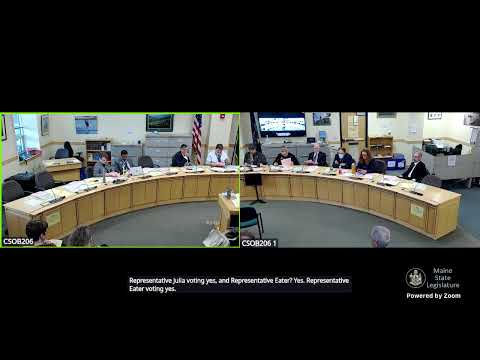
Committee reviews FAME under GEA; adopts acknowledgment and affirms quasi‑independent oversight

Joint Standing Committee on Housing and Economic Development · February 13, 2026

Get AI-powered insights, summaries, and transcripts

Subscribe
AI-Generated Content: All content on this page was generated by AI to highlight key points from the meeting. For complete details and context, we recommend watching the full video. so we can fix them.

Summary

The Joint Standing Committee on Housing and Economic Development reviewed the Finance Authority of Maine’s eight‑year evaluation under the State Government Evaluation Act, heard FAME leaders outline program scale and student‑aid impacts, and voted to adopt a draft letter acknowledging the review and to find FAME met quasi‑independent entity expectations.

The Joint Standing Committee on Housing and Economic Development reviewed the Finance Authority of Maine’s (FAME) program evaluation and voted to adopt a draft letter acknowledging the review.

Carlos Mello, FAME’s chief executive officer, told the committee FAME has supported about 12,000 Maine businesses and facilitated roughly $2.5 billion in direct and indirect financing since its inception, while the state’s capital investment in those lending programs totals about $60,000,000. “We’re an essential component of the state’s workforce and economic development ecosystem,” Mello said during his presentation.

The committee’s analyst distributed an orange packet describing the State Government Evaluation Act (GEA) process: a committee notifies an agency, the agency delivers a program evaluation (statutory deadline Nov. 1), and the committee reviews that report and may issue findings, administrative recommendations or legislation. After hearing the presentation and questions, Representative Feldman moved that the committee send the draft letter included in the packet as its GEA finding; the motion was seconded and approved by the committee.

Members questioned FAME about higher‑education lending and changes to the Free Application for Federal Student Aid (FAFSA). Mello and agency staff said federal aid changes have reduced available supports for some students, and described coordination with the university system, the Alfond Foundation and others to expand alternatives such as private student lending and bond‑backed programs. Mello highlighted education programs FAME administers, including NextGen and Alfond grants, and noted the agency’s role in distributing COVID‑relief business assistance.

The committee also considered FAME’s disclosures of procurements and contributions as part of the quasi‑independent entity review. FAME staff described FY2025 contributions and sponsorships (about $182,000) and explained certain no‑bid procurements — for example, a specialized educational kit vendor — were approved under documented sole‑source or master‑agreement exceptions. After the presentation a motion to acknowledge that FAME met statutory expectations for the quasi review passed by voice vote.

Next steps: the committee’s letter and any recommended follow‑ups will be transmitted in the GEA process.