Council signals deed‑restriction requirement limited to West End as zoning draft is refined
Loading...
Summary
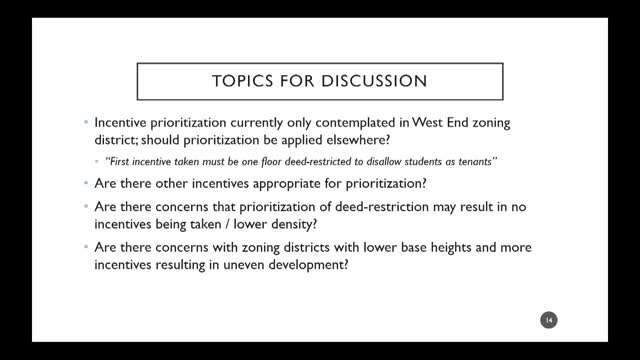
At a Feb. 10 work session, State College City council members directed staff to keep a requirement that the first incentive in the West End be one floor of deed‑restricted non‑student housing, but declined to extend that prioritization to other mixed‑use districts; staff will reflect the direction in the next draft.
Council members at a Feb. 10 work session narrowed a proposed prioritization of zoning incentives so that a deed restriction requiring one floor of non‑student occupancy would remain the required first incentive in the West End district but would not be forced as the first incentive in other mixed‑use areas.
Ed LeClair, the borough’s director of planning, told council the policy goal of the rewrite is to “increase housing opportunities” while ensuring the ordinance is clear and enforceable under Pennsylvania law. LeClair reminded members that state municipal planning law requires unambiguous standards and that incentives must be definable at construction so they can be enforced.
Council discussion split along two lines: some members said prioritizing a deed‑restricted floor is a practical way to promote workforce and longer‑term housing; others warned that requiring the deed restriction as the first incentive could make some projects financially infeasible. Several councilmembers said they feared a hard requirement might become a “poison pill” that discourages development, while others noted deed restrictions have been used successfully in past projects.
After extended discussion and straw polling, council signaled a consensus to: (1) retain the requirement that the first incentive taken in the West End be a single floor deed‑restricted to non‑student occupancy; (2) not extend that required prioritization to the other mixed‑use districts (East Beaver and other MU areas); and (3) increase the draft base heights in the West End and the mixed‑use district modestly (members suggested moving from a 2‑story base to 3 or 4 stories) while adjusting the maximum number of deed‑restricted incentive floors available.
Staff said the direction will be folded into a revised draft to be returned to council in the spring for additional review and that the revisions will also be sent to the county and the Center Region Planning Commission for comment prior to a public hearing later in 2026.
Public commenters at the meeting took contrasting views. Michael Black, a resident and property owner, urged the council to keep a flexible incentive stack in the East Beaver area and warned that mandatory deed restrictions could “create…poison pills” that prevent any building. Other residents urged higher by‑right heights in some locations so more housing can be built without heavy incentives.
Next steps: staff will prepare language in the next draft that implements council’s direction and will circulate that draft ahead of the council’s May review and the broader public review process.