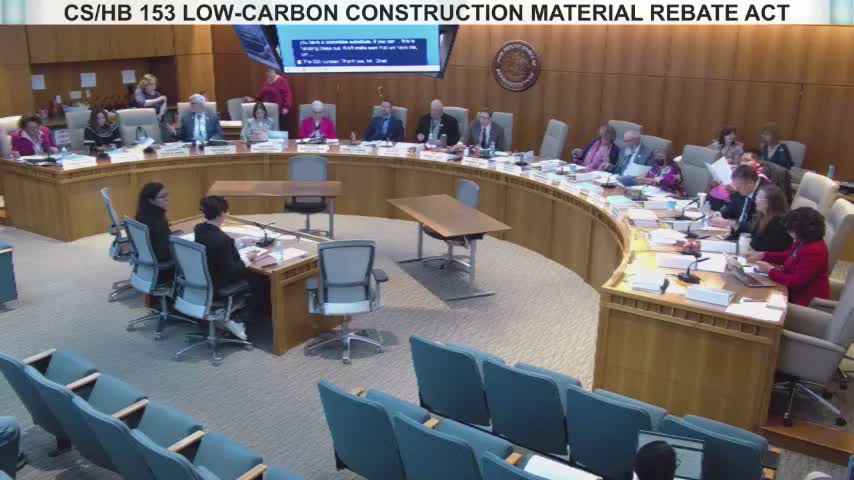
Committee adopts HAFC substitute for industrial decarbonization package, funds rebates and tax credits
Loading...
Summary
The committee adopted a HAFC substitute for House Bill 153, a voluntary industrial decarbonization package combining an Environmental Product Declaration grant program, a Low Carbon Material Rebate and production tax credits/capital grants. Sponsors said $25 million is identified for the rebate program and participation requires EPDs only for program applicants; agencies will administer grants.
The House Appropriations and Finance Committee adopted a HAFC substitute to House Bill 153, advancing a three‑part, voluntary industrial decarbonization package intended to spur low‑carbon manufacturing and markets in New Mexico.
Representative Dixon framed the substitute as a “voluntary market driven industrial decarbonization policy package” built on three complementary programs: (1) an Environmental Product Declaration grant program to help small and medium manufacturers measure and certify product carbon footprints; (2) a Low Carbon Material Rebate to offset 'green premiums' on low‑carbon products and create local offtake; and (3) an Industrial Carbon Reduction Act that would offer production tax credits (presenter cited $85 per metric ton reduced) and capital grants for facilities.
Dixon and the committee’s expert panel clarified that participation is voluntary and that EPDs are not mandatory for public or private projects generally; however, producers must provide an Environmental Product Declaration to qualify for program rebates or grants. The committee’s expert, Dharma Santos Santiago of the National Resources Defense Council, emphasized that the package targets industrial products (for example low‑carbon engineered wood and select manufactured goods) and that hydrogen is only eligible where it is used as an industrial product input rather than for energy generation.
Members raised legal and budget questions. Sponsors said they added guardrails after consulting the Legislative Finance Committee to address anti‑donation concerns by clarifying state returns and program parameters. Funding for the rebate program, sponsors said, was included in House Bill 2 appropriations and $25,000,000 was identified for the rebate pot.
Members also asked about local supply chains and sawmill redevelopment; sponsors pointed to ongoing state efforts to rebuild sawmill capacity and noted program eligibility requires a New Mexico‑based manufacturer to receive benefits. The substitute includes production‑incentive thresholds: presenters said, for example, some production incentives require at least a 40 percent emissions reduction below the baseline to qualify.
Representative Lehi (via the committee motion sequence) moved a combined procedural motion — a 'do not pass' on the original House Bill 153 and a 'do pass' on the HAFC substitute — which the committee recorded after Representative Brown registered opposition. The committee adopted the HAFC substitute and advanced it from committee.
Next steps: the HAFC substitute will be reported out of committee and proceed to additional House action where floor debate and any further amendments may occur.