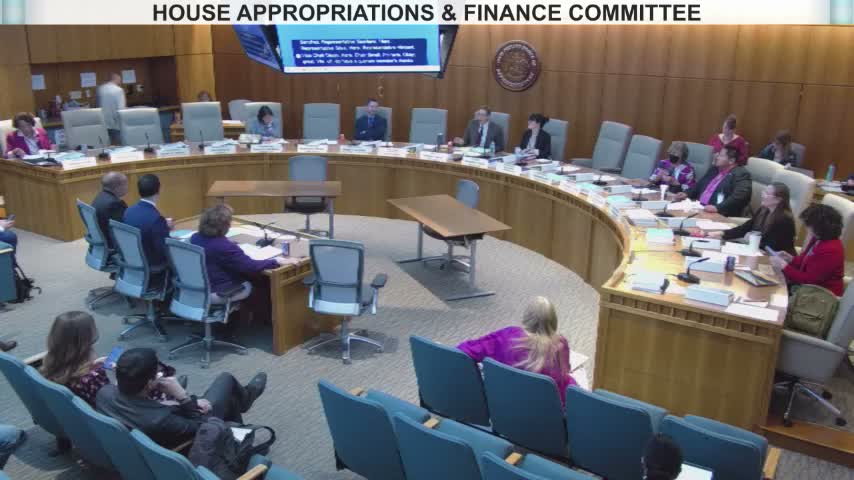
Committee recommends due‑pass on amended bill to adjust funding and reporting for distance learning programs
Loading...
Summary
The House Appropriations and Finance Committee gave a due‑pass recommendation to a substituted, amended bill that removes several restrictions on full‑time distance learning, requires school reporting and authorizes PED evaluations; an amendment averages Gallup Public Schools’ enrollment across two years to soften a projected $49 million funding cliff to roughly $23–26 million.
The House Appropriations and Finance Committee on [date] recommended a due pass for the House Education substitute to House Bill 253 as amended, adopting changes that would remove multiple prior restrictions on full‑time distance learning and add reporting and evaluation mechanisms to the state’s distance‑learning framework.
Representative Garrett, sponsor of the substitute, told the committee that the substitute “eliminates the requirement that students in a full time distance program must reside in a district” and removes a 10 percent cap on enrollment in full‑time distance programs. Garrett said the substitute also deletes a moratorium on new students enrolling in existing programs and changes the State Cyber Academy Act into a broader Distance Learning Act that creates a framework for any future statewide distance program.
The amendment under consideration addressed a separate fiscal problem affecting Gallup Public Schools. A committee presenter described the amendment as replacing a provision that funded Gallup on current‑year membership with a two‑year averaging method: the district’s first reporting date enrollment from this year averaged with last year’s first reporting date. That averaging, staff said, “gives them credit for the work for the students they served last year” while reducing a sudden drop in revenue tied to student movement between districts.
Committee staff explained the magnitude of the impact using rough figures: Gallup’s reported membership fell from about 12,000 students to about 9,000. Under the original substitute language, the district faced an estimated $49,000,000 reduction; the amendment would split much of that loss and reduce the immediate fiscal shock to roughly $23–26 million, depending on final calculations.
Members asked detailed questions about timing, payments and oversight. Representative Herndon pressed staff on whether payments could be timed to avoid overpayments; staff said districts receive monthly installments starting July 1 and that the department uses a fortieth‑day reporting point and statutorily required unit‑value resets (recently moved to February) to reconcile funding. The substitute replaces an application/approval regime for some programs with an evaluative oversight model: local education agencies must report virtual program enrollments and PED may evaluate programs and require remediation or withhold funding if programs fail to meet PED rules.
Several members, including Representative Baca, signaled conditional support while voicing continuing concerns about local impacts, staff reductions and program oversight. Committee members asked whether the students who shifted enrollment were New Mexico residents; presenters said most appear to be in‑state but that reporting historically has been limited, which is one reason the substitute strengthens reporting requirements.
Representative Baca moved a due‑pass motion on the substitute as amended; Representative Silva seconded. The chair asked for opposition and, hearing none, recorded a due‑pass recommendation and moved on to the next items on the agenda. The committee did not record a roll‑call tally for the motion in the transcript.
Next steps: the committee’s due‑pass recommendation advances the amended substitute out of committee; further floor action and any additional amendments will occur in subsequent House proceedings.