Get AI Briefings, Transcripts & Alerts on Local & National Government Meetings — Forever.
Washington House advances package of bills including noncompete ban, PTSD coverage and workforce training
Loading...
Summary
On the House floor members passed a package of bills including a ban on most noncompete agreements (HB 1155), expanded PTSD workers' compensation eligibility for coroners and medical examiners (HB 1002), and a requirement for behavioral-health training in the building trades (HB 2492). Vote tallies and sponsor remarks were recorded on the floor.
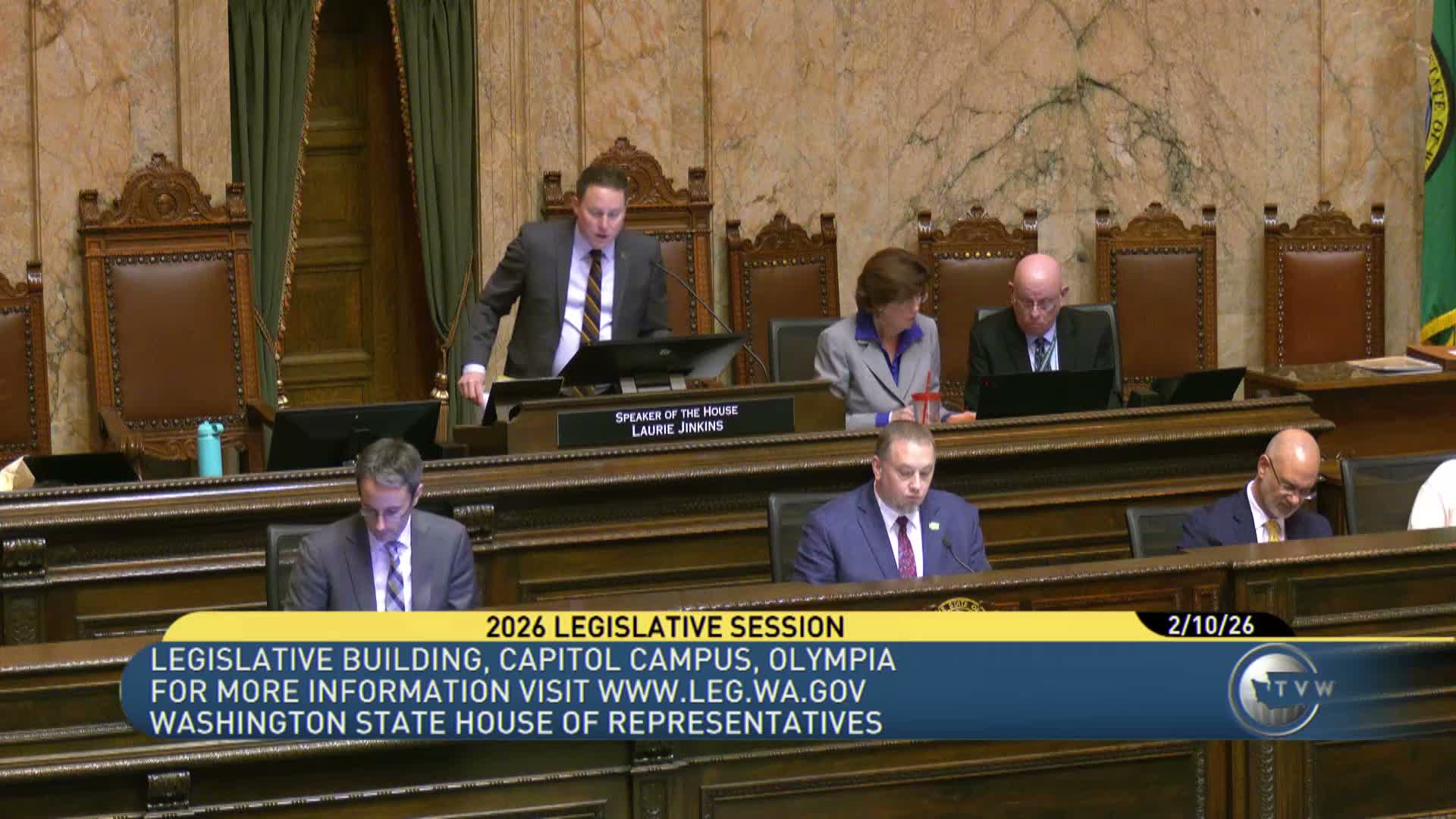
The Washington State House on the floor advanced and passed a slate of bills addressing employment contracts, workers' compensation, food security and workforce training.
Representative Sharon Berry, sponsor of HB 1155, said on third reading: "This bill will ban noncompete agreements in the state of Washington." She argued noncompete agreements "stifle innovation and entrepreneurship" and recounted a constituent who was prevented from practicing locally for three years by a noncompete. The chamber adopted several amendments to HB 1155 addressing tribal employment relationships, clarifying client/patient language and requiring employers to notify certain current and former employees that noncompetes would be void. The final roll-call for HB 1155 was 65 yays, 29 nays, 4 excused; the bill was declared passed.
On HB 1002, which would allow certain coroners and medical examiners to seek workers' compensation for post-traumatic stress disorder, Representative Abarneau noted the measure does not create an automatic presumption but makes a limited class of workers eligible to file PTSD claims. Representative Berry supported the bill as assisting "about a 100 workers in our state" who repeatedly face traumatic scenes. Representative Schmidt urged caution, saying the Department of Labor and Industries may not be prepared to manage such claims and suggested pilots. The final vote was recorded as 70 yays, 24 nays, 4 excused; HB 1002 was declared passed.
Representative Nance, speaking for HB 2492, framed a two-hour behavioral- and mental-health training requirement for apprentices and building-trades workers as a public-safety and suicide-prevention step: "This modest training requirement helps workers better navigate the demands of their job." Opponents warned about cumulative regulatory burdens and potential cost impacts on construction. The bill passed 79 yays, 16 nays, 3 excused.
Other measures passed on the floor included HB 2264 (unemployment insurance clarification), HB 2110 (ambulance interfacility transport personnel), HB 2238 (statewide food security strategy), HB 2445 (tightening probate practices to limit profiteering), HB 2109 (securing vehicle loads), HB 2472 (sprinkler system contractor licensing enforcement) and HB 2229 (Professional Engineers Registration Act updates). Vote tallies were read aloud and recorded on the floor for each measure; several bills advanced by suspension of the rules and were declared passed by the Speaker after the clerk announced the counts.
Lawmakers made multiple technical and policy amendments during floor debate: for HB 1155 lawmakers debated and rejected an amendment that would have exempted senior executives earning above $350,000 from the noncompete ban. Representative McIntyre said that proposal would "allow companies to keep noncompetes in for those very highest earners," and Representative Berry asked members to vote no, arguing it would undermine the bill's intent.
The House session concluded with members preparing to caucus; the Speaker recessed the chamber for caucus and the day's floor business ended with multiple bills declared passed.
Votes at a glance: HB 1155 (noncompete ban) — 65-29-4 (passed); HB 1002 (PTSD eligibility for coroners/medical examiners) — 70-24-4 (passed); HB 2264 — 94-0-4 (passed); HB 2110 — 94-0-4 (passed); HB 2238 — constitutional majority recorded (passed); HB 2445 — 67-28-3 (passed); HB 2109 — 95-0-3 (passed); HB 2492 — 79-16-3 (passed); HB 2472 — 92-3-3 (passed); HB 2229 — 68-26-4 (passed).
The measures declared passed on the House floor will proceed according to the legislative process for enrollment and transmittal as appropriate.