Experts debate presenting Bayesian likelihood ratios to juries; call for transparency and validation
Summary
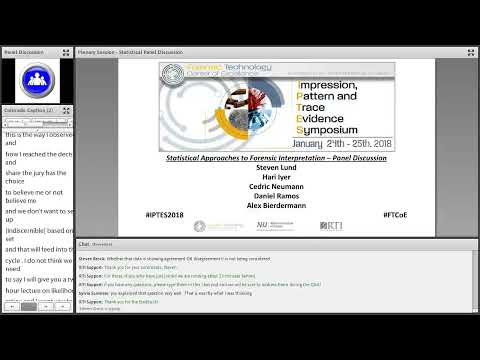
At a technical panel, researchers and practitioners debated whether forensic experts should present Bayesian likelihood ratios in court, focusing on juror comprehension, model uncertainty, instrument differences and the need for clear documentation and empirical validation.
An expert panel meeting explored whether and how forensic experts should present Bayesian likelihood ratios and other statistical measures to juries, with participants stressing transparency about methods and empirical validation as first steps.
Panelists agreed the problem is difficult but important. "Every single 1... this is hard, this is difficult, this is not easy," said Panelist (Speaker 3), summarizing a recurring theme that complexity alone should not halt progress.
Why it matters: Likelihood ratios can compress complex evidence into a single number that a trier of fact might use to update beliefs about a hypothesis. Panelists worried that reducing rich data to one or two scores throws away information and that differing modeling assumptions can produce widely divergent results. "You're basically taking all this wonderful raw data, you're boiling it down to a single number or 2, and you're throwing away a huge amount of information," said Panelist (Speaker 1).
Several panelists described practical ways forward. Dridge of RTI International (Speaker 4) argued experts should place their likelihood ratios within a transparent record of observations and reasoning so jurors can weigh the testimony. "When I'm presenting my likelihood ratio, I need to be very transparent about how I reached it," Dridge said, urging examiners to explain what they observed, how they weighted observations and how they reached their numerical assessment.
Panelists also urged empirical performance data. Speaker 2 and others pointed to inter-laboratory comparisons, including work by the National Institute of Standards and Technology (NIST), as methods to assess whether different labs produce comparable outcomes. Speaker 5 recommended sampling multiple reasonable models to quantify "modeling uncertainty" and present a range of plausible results rather than a single opaque figure.
Instrument differences and calibration were discussed as well. Panelist Speaker 6 noted that methods such as scanning electron microscopy (SEM) and laser ablation ICP-MS (LA-ICP-MS) produce different information content and that more powerful instruments can provide stronger evidence if properly calibrated; however, less powerful methods can still add information when their limitations are documented.
Not all agreed on one path. Henry Swofford (Speaker 9), representing practitioner concerns, asked for a pragmatic first step for laboratories struggling to keep up with methodological change. "What would you propose as a practical way forward for the first step? It may not be optimal," he said. Several panelists responded that documentation, transparency and training should be prioritized so courts see how an expert formed a conclusion and what empirical performance data exists.
What was not decided: The panel did not endorse a single standard for court testimony. Speakers repeatedly contrasted strict Bayesian frameworks with score-based or categorical reporting and called for more community work on validation and calibration before broad courtroom adoption.
Next steps: The session concluded with an agreement to continue the conversation in an afternoon session; panelists emphasized theoretical validation, empirical testing (including black-box studies), and clearer documentation as short-term priorities for the forensic community.
AI generated
The text on this page is AI generated. Summaries, highlights, analysis, and video transcripts are all produced from the original source material.
AI can make mistakes, so if you spot one, and we will fix it for everyone.
Note: the source content is unaltered by us. Any content source we link to, be it a video, an audio recording, or a document, is presented exactly as its publisher released it. That publisher is usually a government body, sometimes an individual official or another organisation.