
UAF institute details new equipment, kelp and livestock trials and asks for $3M operating increase
Get AI-powered insights, summaries, and transcripts
Subscribe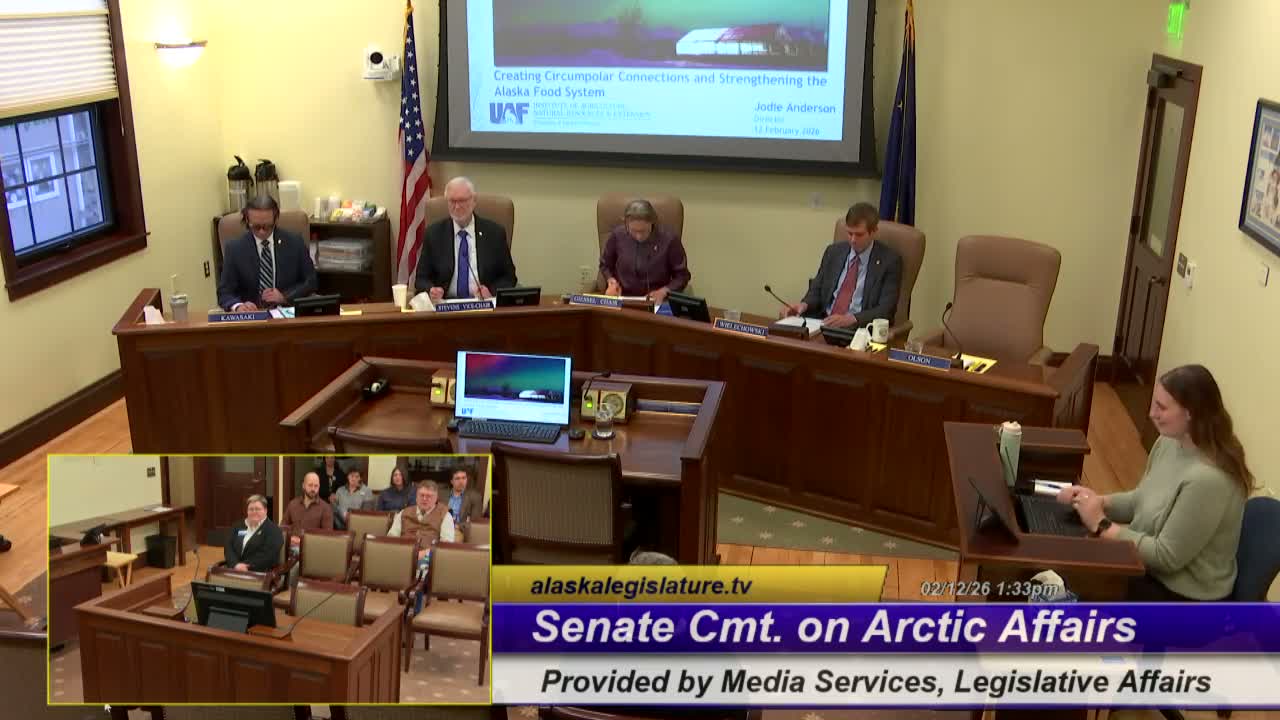
Summary
Jody Anderson, director of the University of Alaska Fairbanks Institute of Agriculture, Natural Resources and Extension, told the Senate Arctic Affairs Committee the institute used a $2 million governor allocation to buy equipment and expand trials and said the institute is seeking a $3 million operating increase in the university red book to hire more researchers.
Jody Anderson, director of the Institute of Agriculture, Natural Resources and Extension at the University of Alaska Fairbanks, told the Senate Arctic Affairs Committee on Feb. 12 that the institute used an allocation from the governor’s office to replace aging equipment, expand livestock nutrition research and launch kelp and forestry projects that she said support Alaska’s food system and circumpolar collaborations.
“We were able to give us $2,000,000 in funding to support our small grains and nutrition, livestock nutrition research work,” Anderson said, describing purchases that included modern plot combines, a six‑row drill, a new tractor and baler, and facility repairs at research farms in Palmer and Fairbanks.
Anderson said the plot combines and new drill address narrow planting and harvest windows in Interior Alaska, reduce labor and data‑collection time, and cut the risk of cross‑contamination among research plots. She described the automated feeding system installed for livestock trials — using microchipped collars to ration feed to individual cattle — as a way to run multiple controlled trials simultaneously without cross‑feeding errors.
The institute’s work also spans forestry and remote sensing. Anderson highlighted a project led by Dr. Santosh Panda that uses satellite imagery and ground truthing to model healthy versus unhealthy forest and to help BLM and state forestry staff anticipate potential fire paths. She described ongoing sensor work to monitor tree moisture and predict vulnerability to pests such as bark beetles.
Anderson also described new applied projects in mariculture and kelp: variety trials testing sugar, ribbon and bull kelp under differing light, salinity and temperature conditions, and an initial study testing whether kelp waste can be processed and used as a livestock feed supplement. She cautioned that kelp‑derived feed requires careful formulation because of iodine risks: "Iodine is a much bigger concern," Anderson said, warning that overfeeding can create iodine toxicity that could transfer into beef.
On crop breeding, Anderson said UAF has a doubled‑haploid genetics lab for small grains that can shorten variety development timelines from decades toward roughly five years for targeted, cold‑tolerant varieties suitable to Alaska and the circumpolar North.
Anderson also framed the institute’s circumpolar engagement: UAF researchers presented at the recent Circumpolar Agriculture Conference in Norway and she volunteered Fairbanks to host the next conference in late August 2028. She described an ongoing speaker series with international participants that the institute is using to expand policy and research connections across Arctic nations.
Beyond the one‑time purchases, Anderson told the committee the institute needs recurring operating funds to hire additional researchers. "We are asking for a $3,000,000 operating, budget increase" added to the university’s red book, she said; Anderson noted the Board of Regents included the request but it was not included in the governor’s budget.
The committee concluded without a vote on any item. Chair Sen. Giesel closed the Feb. 12 meeting and said the committee will meet again Feb. 19 for a presentation on marine vessel tracking.