Get email alerts on the Common Interest Communities topic
No spam. Unsubscribe anytime.
Committee advances substitute to ease rules for small common‑interest communities
Summary
The committee reported the proposed substitute to House Bill 2,354 out of committee with unanimous support; sponsors said the substitute exempts smaller common‑interest and middle‑housing communities from many requirements and raises the audit threshold to ease regulatory burden.
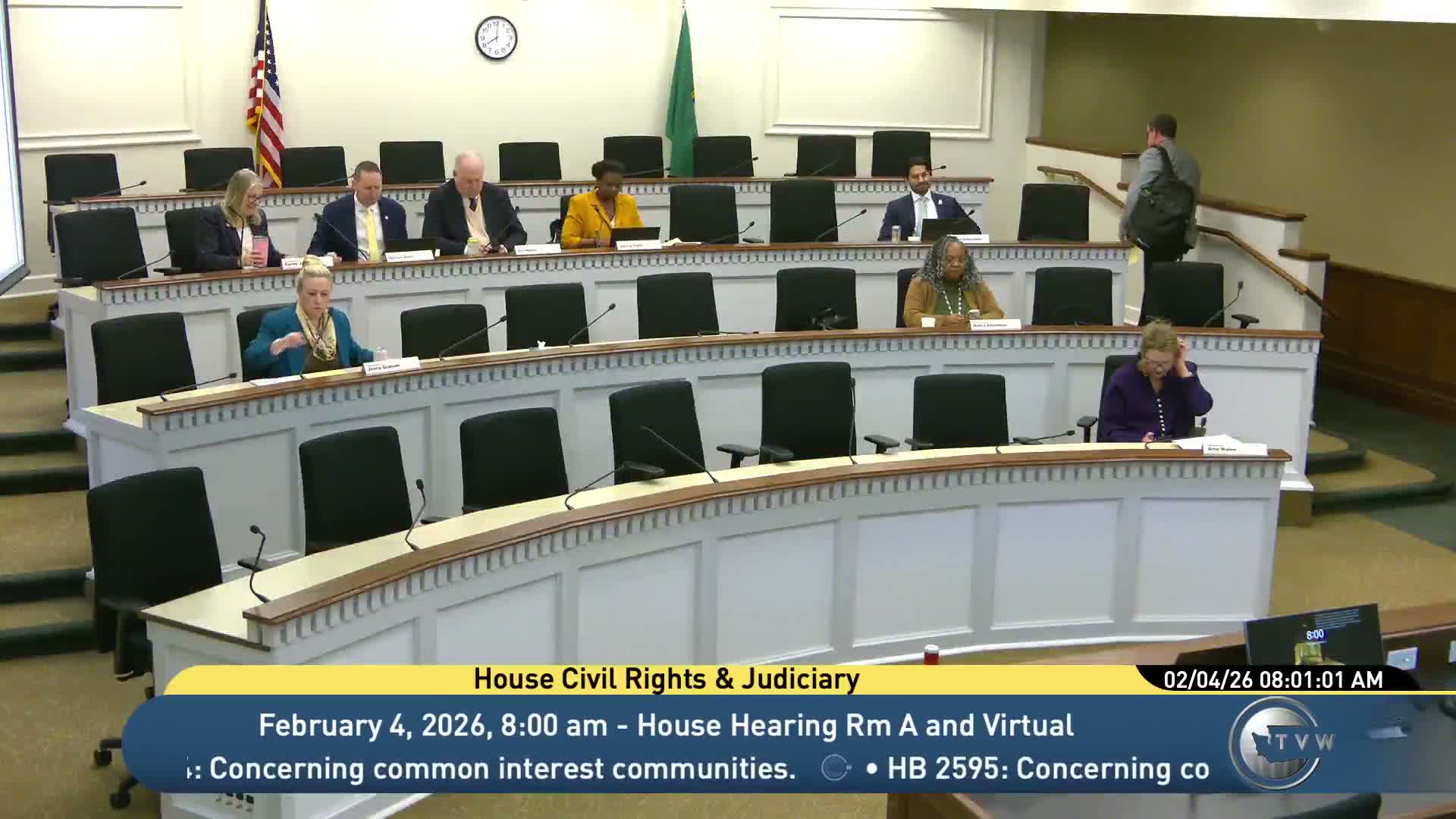
The Civil Rights and Judiciary Committee unanimously reported the proposed substitute to House Bill 2,354 out of committee with a "do pass" recommendation after staff described exemptions for smaller common‑interest communities.
Helena Baker, staff to the committee, said the substitute exempts small common‑interest and middle‑housing communities from many provisions of the state's common‑interest communities law (testimony varied in pronunciation, e.g., "Wukayawa" or "Wakayawah") and from reserve‑study requirements. The substitute also prevents governing documents from differing from the state's law on financial responsibilities for electric‑vehicle charging stations and heat pumps and increases the minimum annual assessment threshold that triggers an audit by a certified public accountant.
Representative Peterson said the measure should make life easier for smaller homeowners' associations and common‑interest communities and asked members for support. Representative Jacobson highlighted the audit‑trigger change, noting the substitute raises the threshold that triggers an annual CPA audit from $50,000 to $100,000 so smaller communities face less regulatory burden.
The committee took a voice vote; staff announced 13 ayes, 0 nays. By that tally, the substitute to HB 2,354 was reported out of committee with a due‑pass recommendation.
AI generated
The text on this page is AI generated. Summaries, highlights, analysis, and video transcripts are all produced from the original source material.
AI can make mistakes, so if you spot one, and we will fix it for everyone.
Note: the source content is unaltered by us. Any content source we link to, be it a video, an audio recording, or a document, is presented exactly as its publisher released it. That publisher is usually a government body, sometimes an individual official or another organisation.