Get Full Government Meeting Transcripts, Videos, & Alerts Forever!
Get email alerts on the North Spokane Corridor topic
No spam. Unsubscribe anytime.
State budget provides $250 million to finish North Spokane Corridor; officials set 2030 goal
Summary
Governor Bob Ferguson and WSDOT leaders announced the 2025 state transportation budget includes roughly $250 million to fund the final three phases of the North Spokane Corridor (NSC), with officials aiming to complete the corridor by 2030 and highlighting community design elements and a $300,000 environmental‑justice study.
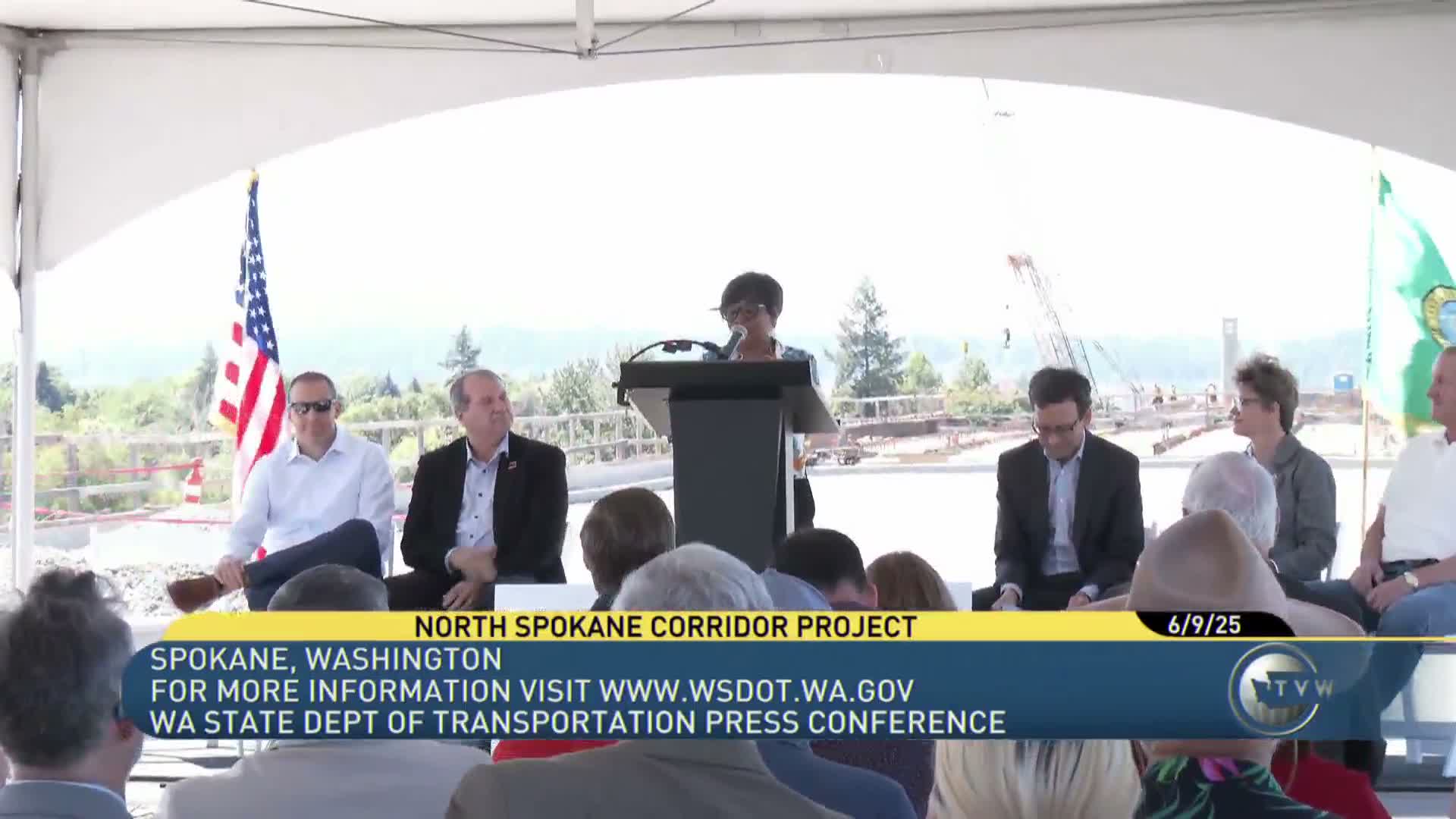
State leaders on stage in Spokane said the North Spokane Corridor (NSC) finally has the funding needed to complete its remaining stages after a decades‑long effort.
Governor Bob Ferguson said the legislature’s recently adopted budget includes “another quarter billion dollars” to fund the final three phases of the corridor, calling the appropriation a landmark step toward finishing the roughly 10.5‑mile project. “The end is now in sight,” Ferguson said, adding that the administration will push to meet a 2030 completion target.
Julie Meredith, appointed WSDOT secretary in 2025, told the crowd the corridor has been shaped by extensive community engagement and highlighted design and art elements along the project’s shared‑use Children Of The Sun Trail — including sunburst motifs on bridges, train imprints at Hilliard, wild‑horse designs under a Minnehaha bridge and a red‑band trout feature near Spokane Community College. “The one word that I hear most often about the North Spokane Corridor is ‘community,’” Meredith said.
Sharra Kaye, regional administrator for WSDOT’s Eastern Region and the event emcee, said construction is actively advancing on the Spokane River Crossing, which she said is scheduled for completion by the end of the year. Kaye described the NSC as a multimodal regional route intended to move truck traffic off local city streets, improve connections to I‑90, and support bus rapid transit along Division Street.
State legislators who attended framed the funding as the product of sustained local advocacy. Sen. Marcus Rucelli said completing the corridor will create jobs and improve access to education, health care and employment, and thanked Spokane advocates for pressing lawmakers to secure the appropriation. Sen. Leonard Christian and Sen. Jeff Oley also praised bipartisan work to place the project among scarce statewide transportation priorities.
Officials also noted a $300,000 appropriation in the recent budget for an environmental‑justice impact study intended to evaluate uses of surplus land — including opportunities for housing and parks — and to address historical impacts of earlier highway projects. That study was raised by elected officials as a commitment tied to next steps in land use and community mitigation.
During a brief media question period, reporters asked about funding balance between projects on Washington’s West Side and Eastern Washington. Ferguson and WSDOT officials said budget decisions are trackable in the state appropriation and defended the corridor’s prioritization in the 2025 transportation budget. They also acknowledged risks to schedule such as tariffs and workforce availability but said committed funding reduces the budget uncertainty that previously hampered progress.
The press conference closed with officials reiterating the project’s potential benefits — reduced congestion on city streets, economic development and multimodal access — and inviting media for follow‑up questions. Officials repeated the goal of completing the funded final phases by 2030 and thanked local partners and crews for sustained work.
Next procedural steps identified at the event included continued construction of the Spokane River Crossing, completion of trail connections later this year and project oversight tied to the recently adopted state transportation budget.