Get email alerts on the Appointments Rules topic
No spam. Unsubscribe anytime.
Clark County planners review rule adding council appointment process, debate public interview questions
Summary
At a Feb. 19 work session, Clark County Planning Commission staff proposed adding a rule that formalizes the county council's appointment process. Commissioners questioned a requirement that council interview questions be set in public and identical for all candidates and asked staff to consult the county manager and human resources before the March hearing.
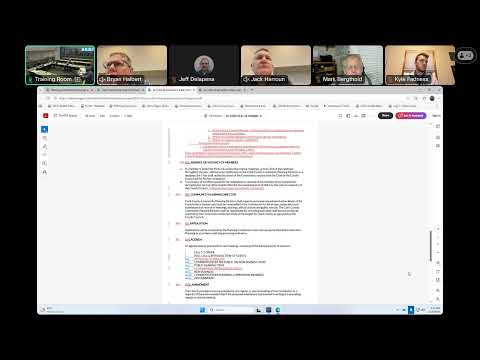
The Clark County Planning Commission on Feb. 19 considered a proposed amendment to its rules of procedure that would add Section 12, formalizing the county council's process for appointing and reappointing commission members.
Oliver Ojeko, the county's community planning director, told commissioners the language is drawn from the county's board-and-commission appointment process and noted the change would explain how the county solicits letters of interest and resumes, forwards candidate materials to council, and schedules interviews that are publicly viewable over Webex. "What we have before you is, a proposed amendment to, your rules of procedure," Ojeko said, adding the section is "just verbatim" from the board-and-commission appointment rules.
Commissioners raised concerns about a clause that says interview questions "will be determined in a public meeting and will be the same for all candidates." Vice Chair Jack Haroun said the requirement could box applicants into "a very rote, like, formulate box" and limit the commission's ability to explore candidate-specific expertise. "It kinda seems like they must if they participated in the public portion of it, they would understand what the questions were," one commissioner said, while Haroun cautioned that identical questions might prevent follow-up that probes specialized experience.
Staff and other commissioners defended the practice as standard and intended to promote fairness and transparency. Ojeko said council practice typically includes a public portion on Webex where the panel reviews and agrees on questions before calling candidates in; he also noted the council cannot vote on appointments in executive session and that final action must be public.
Commissioner Berthold urged staff to consult county human resources to confirm whether the proposed language aligns with personnel procedures used for other hiring and appointment processes. Ojeko agreed to pass the suggestion to the county manager and said staff could delay or pull the scheduled March 19 hearing if the manager recommended changes. "We can certainly ask the county manager," he said, adding the proposal would not be changed unilaterally by staff because it mirrors council-adopted ordinance language.
Separately, commissioners debated whether work sessions should more explicitly invite public input earlier in the review process. Several members proposed adding an encouragement to submit written or video testimony to the work session script and to the website, so members of the public can provide substantive input before items reach the hearing stage.
Ojeko also told commissioners they had been invited to a March 18 council work session on transfer-of-development-rights (TDR) topics and an interlocal agreement with the city of Richfield; staff had transmitted the commission's recommendation and verbatim minutes to council and said commissioners were welcome to attend.
The commission did not vote on the rule change at the Feb. 19 work session. Ojeko said he would share the commissioners' questions and concerns with the county manager and that the March hearing could be postponed pending that review.
AI generated
The text on this page is AI generated. Summaries, highlights, analysis, and video transcripts are all produced from the original source material.
AI can make mistakes, so if you spot one, and we will fix it for everyone.
Note: the source content is unaltered by us. Any content source we link to, be it a video, an audio recording, or a document, is presented exactly as its publisher released it. That publisher is usually a government body, sometimes an individual official or another organisation.