Get Full Government Meeting Transcripts, Videos, & Alerts Forever!
Get email alerts on the Tax Expenditures Review topic
No spam. Unsubscribe anytime.
Finance, Revenue and Bonding working group opens review of state tax expenditures
Summary
Representative Maria Horn convened a bipartisan working group to inventory state tax expenditures, starting with corporate tax credits reportedly claimed by very few taxpayers; members asked agencies to compile data, clarify administrative costs, and return in January with a prioritized list for cleanup or further study.
Hartford — Representative Maria Horn convened the Finance, Revenue and Bonding working group on Monday and set two primary objectives for the panel: identify short-term tax-code "cleanups" and develop long-term standards for measuring whether tax expenditures achieve their intended goals.
"I'd like to come out of this with some short-term goals of things that we might be able to clean up and make our tax code simpler and clearer for people," Horn said, identifying transparency and the long-term fiscal implications of tax expenditures as central concerns. Horn opened the meeting by urging a data-driven approach and asking staff to assemble relevant external and internal reports for committee review.
The group agreed to an initial focus on corporate tax expenditures that appear to be used by very few taxpayers. "Many of these credits are not claimed by anyone," said Matt Dayton, undersecretary for legal affairs at the Office of Policy and Management (OPM), noting both the administrative cost of keeping unused provisions on the books and the need to assess whether credits accomplish their stated goals.
State agencies present described available data and limits. John Biello, deputy commissioner at the Department of Revenue Services (DRS), said DRS maintains extensive taxpayer data but sometimes suppresses detail when claimant counts are fewer than 10 to protect privacy; members discussed how to interpret "data not available" entries in the tax-expenditure report and whether those entries likely indicate very low utilization.
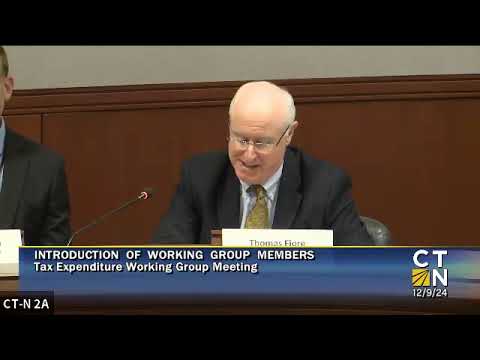
Tom Fiore of OPM's budget division recalled a 2019 review that generated about 20 recommendations but resulted in only three statutory changes, illustrating the political and procedural hurdles to removing or altering existing tax provisions. Fiore's recounting underscored participants' repeated caution that even apparently unused or narrowly targeted credits can have entrenched support.
Department of Economic and Community Development (DECD) staff urged careful measurement of incentives. David Stuber, DECD's chief of staff and director of strategic initiatives, said the correct evaluation metric depends on statutory intent: some credits aim to create or retain jobs, others to generate direct fiscal revenue or broader economic activity. Using the film tax credit as an example, Stuber noted different evaluation assumptions can produce opposing conclusions about a program's value.
The group weighed several screening criteria for prioritizing candidates for cleanup: claimant counts (including a focus on credits used by fewer than 10 taxpayers), aggregate dollar value of credits claimed, and the annual administrative burden on agencies that must publish forms, guidance and process claims. Members also discussed the option of time-limited "sunset" provisions to force periodic re-evaluation; Representative Cheeseman framed sunsetting as a way to increase accountability but others cautioned that automatic sunsets can generate large reporting loads and encourage routine renewals.
Horn asked members to send existing studies and resources — including reports from Pew Charitable Trusts, the National Conference of State Legislatures (NCSL) and the Volcker Institute — to the clerk identified as Ash so staff can circulate a compiled packet before the next meeting. The panel agreed to reconvene in January to review a prioritized list of corporate tax expenditures and additional items identified for later study.
No formal motions or votes were taken. The working group began by assigning data-collection and resource-compilation tasks to staff and state agencies; it will use that information to determine which expenditures merit statutory change, further study or preservation.
The committee's next meeting is expected in January; staff will circulate scheduling options.