Get Full Government Meeting Transcripts, Videos, & Alerts Forever!
Get email alerts on the Washington Thriving topic
No spam. Unsubscribe anytime.
HCA presents 'Washington Thriving' strategic plan as state wins $181 million federal award
Summary
HCA officials briefed the advisory committee on Washington Thriving, a prenatal-through-25 behavioral-health strategic plan, and announced Washington received a federal Rural Health Transformation award worth about $181 million for 2026–2030; HCA said it will review award terms and publish implementation details.
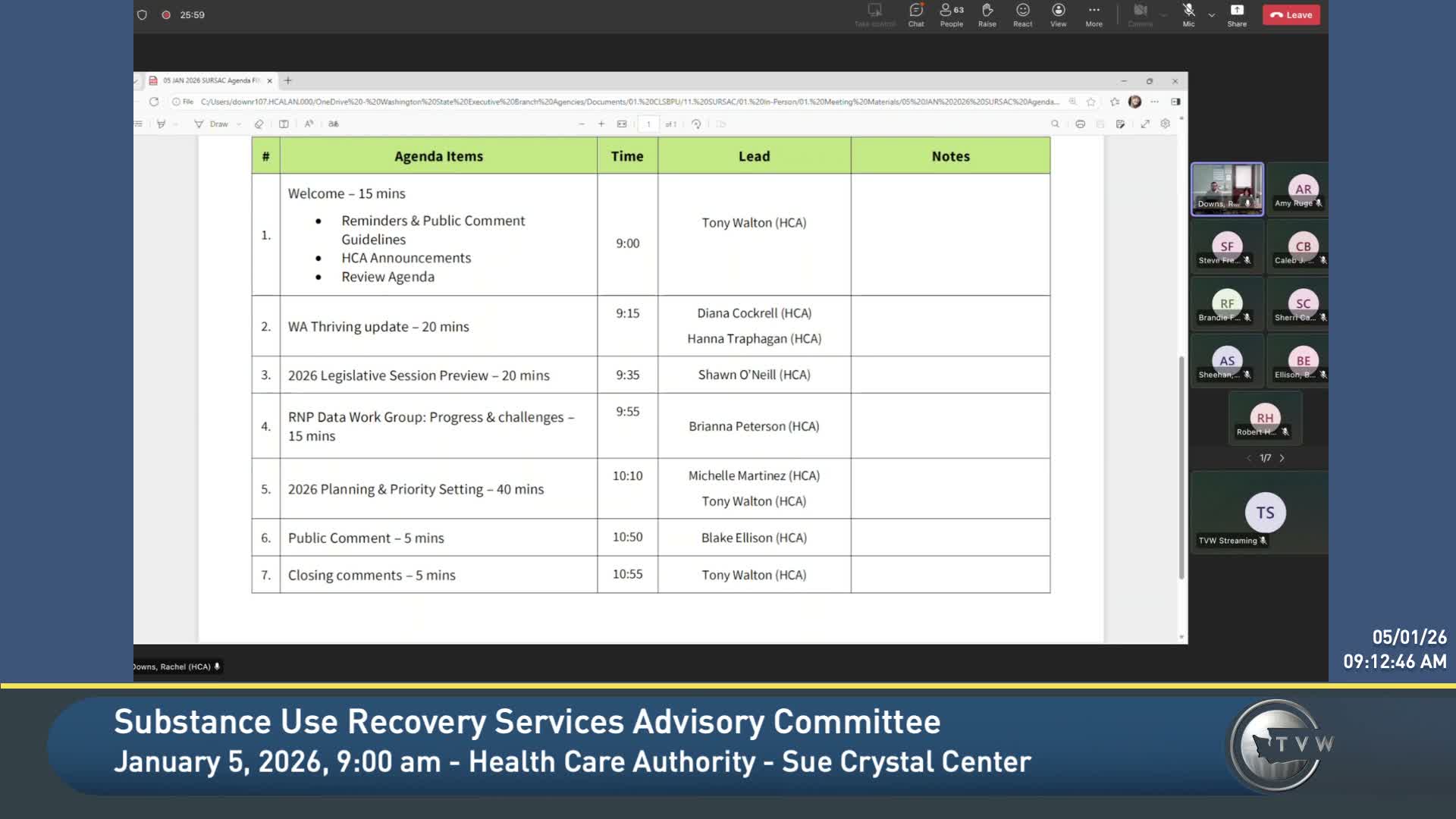
Chair Tony Walton opened the meeting and announced what he called "really, really good news" that Washington had won a federal Rural Health Transformation grant. "Washington State received $181,000,000 and a little bit more, for federal fiscal year '26," Walton said, and HCA staff are reviewing the award notice and its terms.
Diana Cockerill, section manager in HCA’s Division of Behavioral Health and Recovery, introduced Washington Thriving, the state’s strategic planning effort for prenatal-through-age-25 behavioral health. "This is the Washington strategic planning effort for prenatal through age 25 behavioral health called Washington Thriving," Cockerill said, explaining the plan grew from a legislatively assigned Children Youth Behavioral Health Work Group and a multi‑year advisory process centered on lived and frontline experience.
Why it matters: Washington Thriving lays out a long‑term road map and immediate priorities to strengthen governance, expand services across prevention, treatment and recovery, and create values‑in‑action such as trauma‑informed, equity‑centered care. Cockerill said early implementation work will focus on governance structures and outcomes monitoring so policymakers and communities can track whether purchased services and policies are improving results.
Details from the presentation: HCA described three foundational dimensions — strengthening infrastructure, expanding offerings across the prenatal‑to‑25 lifespan, and embedding values-in-action — plus cross‑cutting recommendations on outcomes monitoring and funding coordination. The presenters said outcomes monitoring should be transparent, vetted by people with lived experience, and used to align funding across federal, state and other sources.
On specific services: Committee members asked whether medications for opioid use disorder (MOUD) for young people were explicitly prescribed by the plan. Cockerill said the strategic plan was intentionally non‑prescriptive on age‑specific program mandates: MOUD and other clinical approaches "fit" within the plan’s service‑expansion buckets, allowing local and clinical partners to define specifics during implementation. Hannah Trappagen, a project team member, added the plan sought to create “buckets in which everything can fit” so different regions and providers can adapt interventions over time.
Next steps and contact: Presenters posted a project inbox and community toolkit in the meeting chat and invited written feedback; the plan and supporting materials are available at washingtonthriving.org. HCA said it will continue publishing implementation updates on the agency website as it reviews grant terms and coordinates across divisions.
The committee did not vote on the plan during the meeting; staff asked members to provide feedback by email or via scheduled follow‑up opportunities ahead of future meetings.