Get email alerts on the Protocol Changes topic
No spam. Unsubscribe anytime.
Wolf advisory group splits over whether to codify range-writing clarifications into protocol
Summary
Members of the Washington Wolf Advisory Group debated whether to append a 2025 recommendations letter to the wolf-livestock interaction protocol, create narrow clarifying addenda, or keep the letter separate. The group agreed to continue implementation conversations, scope subgroups and gather targeted input ahead of an April meeting with the director.
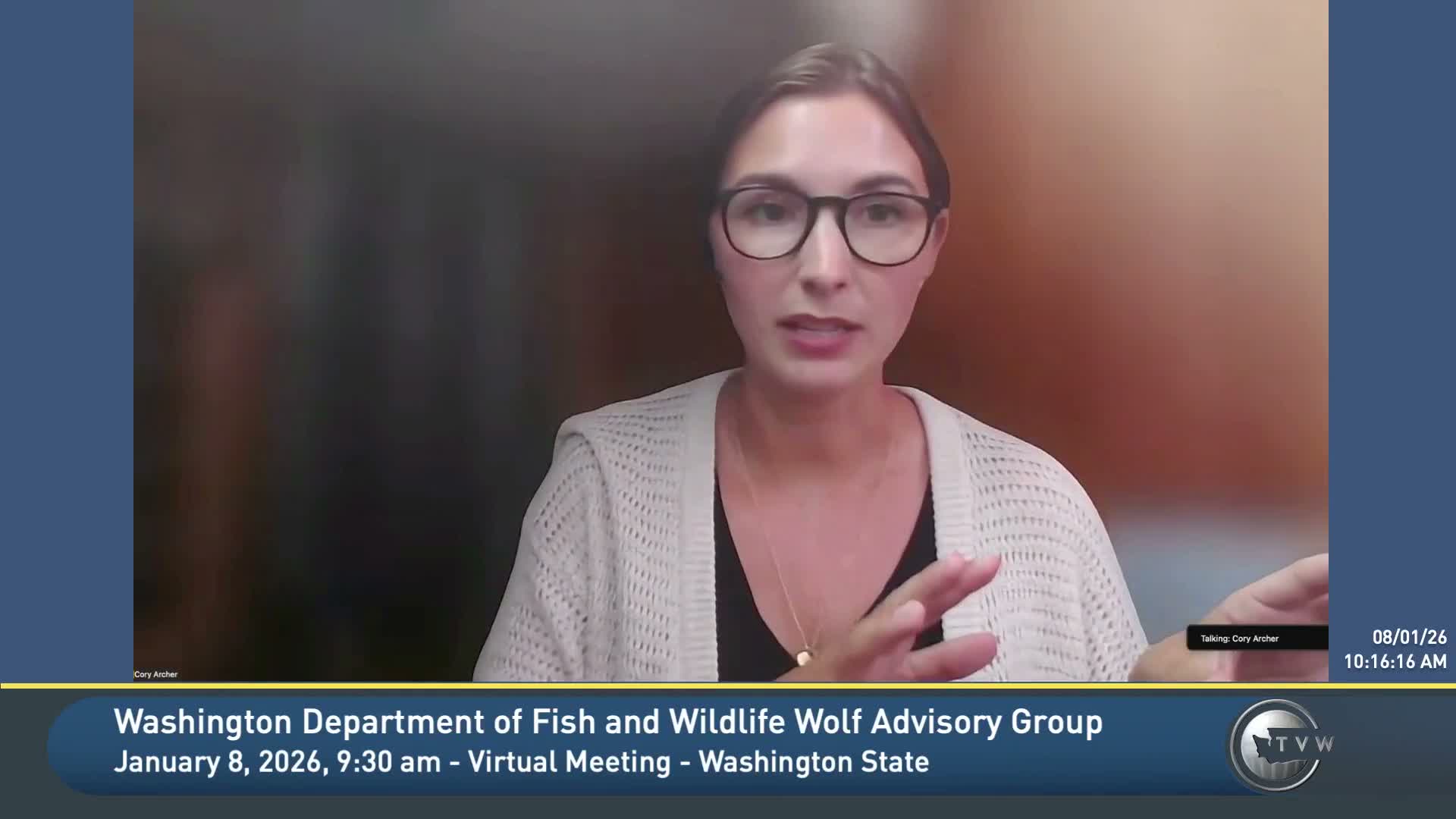
Members of the Washington Wolf Advisory Group spent the bulk of a virtual two-hour session debating how and whether to incorporate a 2025 set of range-writing recommendations into the state'level wolf-livestock interaction protocol.
The discussion began after facilitators reminded participants that the group's 2025 recommendations letter was delivered and that the director had asked staff to return with implementation questions. Department policy lead Shubh Bhattacharjee told the group it was asking WAG for advice on how the agency should respond to and implement the recommendations. "We got your points," he said during the meeting, "now help us to address those challenges." (Shubh Bhattacharjee, WDFW, SEG 1939'1949)
Why it matters: the debate touches on whether language intended to clarify that range riding is not mandatory should be appended directly to the protocol, kept as a standalone letter or guidance, or turned into a narrowly targeted addendum. Proponents, including WAG member Paula Swadin, argued that key clarifications could be lost if they remain only in a letter and urged a concise addendum: "Republish the protocol with that letter as an amendment or an addendum." (Paula Swadin, Conservation Northwest, SEG 2556'2558)
Opponents, largely representing producer interests, urged caution. Scott Nielsen, a rancher on the group, said the protocol'consensus process must be preserved and that any change to the document should be made only by WAG consensus. "The protocol is the protocol," he said, arguing that some members felt the group's earlier consensus had been questioned and that the process must be respected (Scott Nielsen, producer representative, SEG 1531'1536). Several producers said the 2025 letter was primarily a clarification and that reopening protocol text without clear, full-group agreement would be a mistake.
Where the group landed: rather than an immediate vote to change the protocol, members agreed to continue the implementation conversation. The facilitator said the next steps are to (1) pursue targeted, shorter conversations about how recommendations would be implemented in practice; (2) compile asynchronous input on specific implementation questions; and (3) consider a narrowly scoped addendum if the full group comes to consensus. The facilitator also plans to circulate a follow-up email to capture volunteers for a nonlethal-technology/data-sharing subgroup and other task groups.
What remains unresolved: participants remain divided on whether adding an amendment or addendum is the right path. Some members urged a surgical change limited to range-writing language; others said the letter already clarifies the protocol and called further action unnecessary. WAG members also flagged operational questions that need answers before any codification'for example, what preseason consultation will look like in practice and how agreements between producers and department staff will be documented.
Next procedural step: the group will continue implementation-focused conversations before deciding whether to propose protocol edits. The WAG will gather asynchronous member input on prioritized implementation questions and will bring the topic back to the April in-person meeting, at which the director will attend a session on the second day (Shubh Bhattacharjee, WDFW, SEG 3810'3812).
AI generated
The text on this page is AI generated. Summaries, highlights, analysis, and video transcripts are all produced from the original source material.
AI can make mistakes, so if you spot one, and we will fix it for everyone.
Note: the source content is unaltered by us. Any content source we link to, be it a video, an audio recording, or a document, is presented exactly as its publisher released it. That publisher is usually a government body, sometimes an individual official or another organisation.