Get Full Government Meeting Transcripts, Videos, & Alerts Forever!
Get email alerts on the Transportation topic
No spam. Unsubscribe anytime.
Takoma Park holds public consultation on FY2027 sidewalk and traffic‑calming requests; officials outline scoring, jurisdiction and next steps
Summary
City staff presented FY2027 sidewalk and traffic‑calming requests by ward, explained technical scoring and feasibility checks, said some items were forwarded to enforcement or state/regional agencies, and reminded residents the comment period is open through Feb. 20.
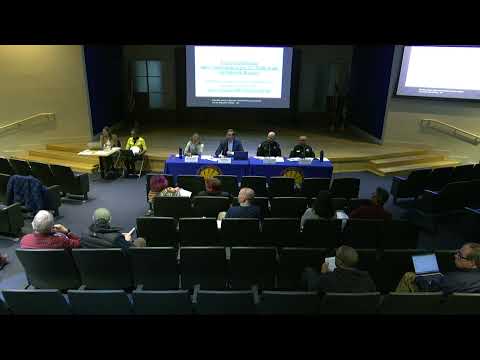
Takoma Park staff convened a public consultation to gather resident input on sidewalk and traffic‑calming requests submitted for fiscal year 2027, laying out how proposals will be scored, which items are being forwarded to other agencies, and how planned traffic studies will feed into the city’s budget process.
"We're here to hear comments about requests for sidewalks and traffic calming," said Devin McNally, director of the city’s Housing and Community Development Department, who opened the meeting and walked through the intake and scoring process. Staff said five technical metrics will be used — equity, safety, trip generators, roadway characteristics and population impact — and that feasibility (right‑of‑way, utilities, topography) is the only factor that can rule a request out.
The city organized requests by ward and displayed maps of proposed sidewalks (lines) and traffic‑calming features (dots). McNally said some submissions that fall on state highways are forwarded to the Maryland State Highway Administration (SHA) and that items on Sligo Creek Parkway are transmitted to the regional parks planning agency for review. "We would certainly have to get State Highway's permission to install sidewalk along the state road because it is their right of way," Public Works Director Darryl Braithwaite said when asked about Ethan Allen Avenue.
Staff told attendees that enforcement issues such as speeding or suspected stop‑sign violations are routed to the police department: "We have a traffic enforcement unit that will go out and evaluate each concern," Deputy Chief Shabu Filipos said. Captain Matthew Mazzotti added that the department is collecting data, including from a new stop‑sign camera pilot; staff said 18 stop signs currently have camera enforcement.
Residents raised safety concerns in several neighborhoods. A parent who lives on Hayward Avenue said the sidewalk ends between Auburn and Larch and that walking there with a young child forces pedestrians to dodge parked cars. "As a pedestrian who walks that often, and I have a one‑and‑a‑half‑year‑old, it can be a little bit where I'm kind of dodging between parked cars," the resident said. Multiple commenters pressed for sidewalks or speed humps on Elm, Larch, Central and other streets that provide routes to bus stops and schools.
Roger Schlegel, who spoke about several locations, described narrow or intermittent sidewalks near bus stops and a pattern of children running into the street on parts of 5th Avenue. Several participants asked why marked crosswalks and certain traffic‑control measures were recorded separately from the sidewalk/traffic‑calming intake. Braithwaite said crosswalks are lower‑cost, marking‑based treatments that the city intends to evaluate on a citywide set of criteria (pedestrian generators, proximity to schools and bus stops) rather than through the construction‑oriented sidewalk process.
The city also confirmed two consultant traffic studies will be folded into the FY2027 evaluation. McNally said recommendations coming from the Ward 6 New Hampshire Gardens study (including Flower Avenue and Lincoln Avenue areas) will be presented to the City Council at its Feb. 25 meeting and then scored and considered alongside resident requests. Staff said the Maple Avenue connectivity project was funded with a state design grant and would require additional council direction and funding to move to construction.
Staff clarified policy and next steps for several items: some submissions were classified as maintenance or ADA compliance and forwarded to Public Works for action; contraflow bike lanes and bicycle infrastructure are considered in a separate review process; and items listed as "done" (for example, the Hancock Avenue sidewalk) mean approved for design (FY26), not construction complete. Braithwaite described the design phase process and said engineering firms will produce base maps, tree inventories and design options before a public community meeting and further comment.
The city will publish the full master list of submissions and staff explanations on its project web page and posted a Google form to accept written comments. McNally closed by reminding listeners that the public comment period remains open through February 20 and that recommendations will return to City Council for funding consideration.
There were no formal votes or final council actions taken at the meeting; staff said projects will be scored and presented to council during the FY2027 budget process.