Lifetime Citizen Portal Access — AI Briefings, Alerts & Unlimited Follows
Minnesota State urges $1M–$1.5M identity-proofing investment to curb enrollment 'ghost students'
Loading...
Summary
Minnesota State presented the Enrollment Fraud Working Group report to the Senate Education Committee, calling for an automated identity-proofing system (estimated $1 million–$1.5 million annually), expanded cross-functional safeguards, equity impact assessments, and annual legislative reporting to protect financial aid and institutional systems.
St. Paul — Officials from Minnesota State Colleges and Universities told the Senate Education Committee that enrollment fraud involving so-called "ghost students" has grown with online learning and recommended a systemwide investment in automated identity proofing to protect federal aid and campus systems.
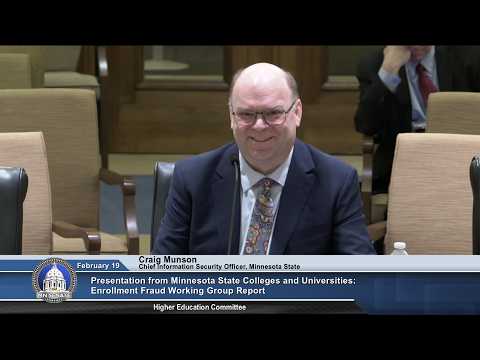
Craig Munson, Chief Information Security Officer for Minnesota State, told the committee that ghost students are "fraudulent enrollments created using stolen or fictitious identities" that can be used "to illegitimately obtain government aid and other institutional services." He said fraudsters operate at scale, often from outside the United States, deploying automation and artificial intelligence to attempt hundreds of fraudulent enrollments per day.
The working group convened under 2025 session law to assess vulnerabilities and issued several recommendations. Munson said the most impactful safeguard would be an automated identity-proofing system deployed across Minnesota State's 33 colleges and universities, with an estimated annual cost of roughly $1 million to $1.5 million for acquisition, implementation, support and maintenance. He added that newer commercial solutions are now better suited for younger students and those without established credit histories.
The report also recommends continued cross-functional collaboration between academic, student-affairs and cybersecurity teams, formalizing the fraud working group as a standing committee, enhanced training and awareness for admissions and financial-aid staff, equity impact assessments before new safeguards are implemented, and annual legislative reporting on trends and system performance.
Faculty and student witnesses described burdens and risks that accompany enforcement at the campus level. Mark Grant, a communication studies faculty member at Dakota County Technical College speaking for the Minnesota State College Faculty (MSCF), said faculty helped surface ghost-student activity and are "struggling a little bit with what to do when they do slip through in our classes," describing instances where instructors must schedule many individual Zoom calls to verify authenticity.
Jovita Morrison Gallimore, vice chair of Students United, said the issue affects financial-aid integrity, classroom disruption and cybersecurity. "Protect access while strengthening safeguards," she told the committee, urging that identity-proofing tools be designed so they do not unintentionally delay or deter legitimate students, particularly first-generation and low-income students.
Committee members asked for prevalence and financial-impact figures. Munson offered a wide range on flagged applications in oral testimony and said most are stopped before enrollment; he declined to provide detailed detection metrics in public for fear of tipping off fraudsters but offered to share more precise data with members offline. Munson described the immediate response when fraud is detected: the system alerts all 33 colleges, suspends the account and places holds on financial aid, and Minnesota State notifies the U.S. Department of Education for any further federal action.
The hearing concluded with members requesting additional figures on prevalence and costs. Minnesota State signaled it would provide further data to the committee administrator. Chair closed the session and announced the next presentation (U of M Fairview on an M Health agreement).