Get AI Briefings, Transcripts & Alerts on Local & National Government Meetings — Forever.
Committee approves amendment and refers bill to clarify tort-liability treatment for rural water and sewer systems
Loading...
Summary
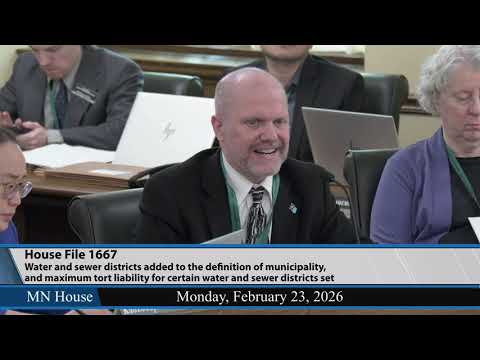
The House committee approved an amendment and forwarded HF1667 to Judiciary after testimony from rural water managers seeking explicit inclusion of water and sewer districts in Minnesota's political-subdivision tort-liability cap to avoid bankrupting nonprofit public systems.
A House Elections Finance and Government Operations Committee approved an author's amendment and voted to refer House File 1667 to the Judiciary Committee after testimony from rural water managers who urged explicit statutory protection for water and sewer districts.
The bill, introduced by Representative Schumacher, would treat water and sewer systems formed under chapter 116A as municipal entities for purposes of Minnesota's cap on political-subdivision tort liability. "Our real water entities are all government, not for profit organizations, which were created for the sole purpose of drinking water to many thousands of individuals and cities who reside within our system," Dominic Jones, manager of Red Rock Rural Water System, told the committee.
Supporters said that without a clear statutory cap, a successful lawsuit could bankrupt a rural system and jeopardize water service to thousands of residents. Jones said Lincoln Pipestone serves more than 5,000 homes and businesses and 37 cities, and Red Rock serves multiple cities and rural customers unable to afford their own treatment plants.
Craig Johnson of the League of Minnesota Cities cautioned that existing law and joint-powers provisions might already cover such entities and that explicitly adding more categories could create confusion about which entities are protected. Committee members said those legal ramifications would be examined in Judiciary.
The committee also approved the author's A1 amendment, which changes the bill's enactment date from 2025 to 2026. Representative Alten Dorf renewed the motion that HF1667, as amended, pass and be referred to the Judiciary Committee; the motion passed by voice vote.
The next step is review in the Judiciary Committee, where members said they expect to resolve statutory definitions and any overlap with existing joint-powers language.