Get AI Briefings, Transcripts & Alerts on Local & National Government Meetings — Forever.
Alaska Community Foundation to administer Rural Health Transformation funds; committee presses on reporting, eligibility and timelines
Loading...
Summary
The Alaska Community Foundation told the Senate Health and Social Services Committee it will manage intake, compliance and award processing for federal Rural Health Transformation Program dollars, emphasizing technical assistance, a single-LOI pathway and reporting obligations tied to CMS guidance and tight federal spend deadlines.
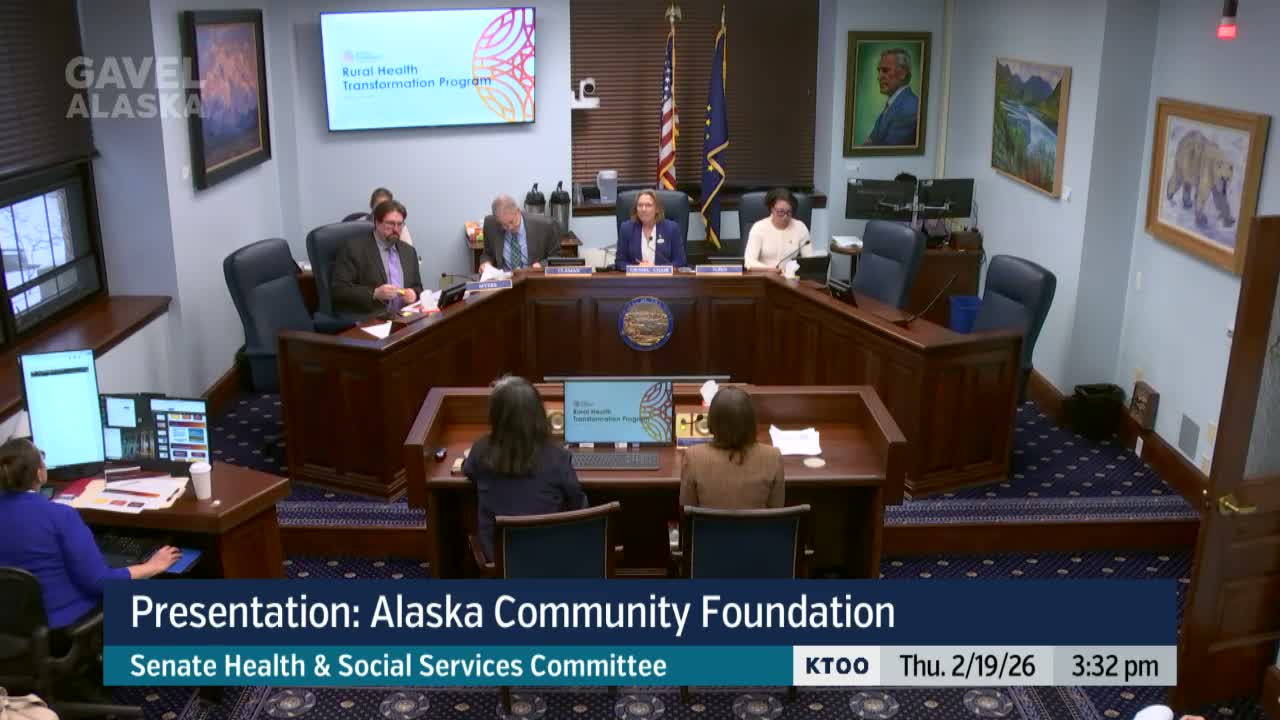
The Alaska Community Foundation will serve as the administrative platform for Alaska’s Rural Health Transformation Program (RHTP), Alaska Community Foundation President and CEO Alex McKay told the Senate Health and Social Services Committee on Thursday.
“We’re not decision makers. We’re not policy setters,” McKay said. “We actually administer ... as grantmakers the parameters of the program, as we are given.” He and Megan Casciola, the foundation’s vice president of programs and grants, outlined how the foundation will manage a single registration and letter-of-interest (LOI) portal, coordinate an expert review team of local grantmakers and forward grouped recommendations to the Department of Health for final award decisions.
The nut of the presentation was how ACF intends to bridge statewide reach and local knowledge. Casciola described a 12-affiliate model and a set of regional partners that provide local due diligence and community input while ACF handles transaction processing and reporting. “We want to encourage everyone to be able to apply at whatever stage of readiness they are,” McKay said, describing award pathways that range from low-barrier planning grants to full implementation proposals.
Committee members pressed procedural and fiscal questions. Senators asked whether subrecipients must be 501(c)(3) charities, how funds will be paid, how ACF will be compensated and what compliance and audit requirements will apply. McKay and Casciola said eligibility is broad — tribes, for-profits and faith-based groups that serve the general public can apply — but applicants must have EINs, SAM.gov registration and meet federal grant compliance standards. On payment flow, McKay said awards will be processed through the Alaska Community Foundation and that ACF will be paid from the grant dollars under a scope of work rather than a flat percentage; he estimated the administrative fee would be “less than 0.5%,” and senators noted the federal administrative cap is 10% of the overall award.
Senators also focused on oversight. McKay said ACF’s role will prioritize reporting and monitoring and that on-the-ground enforcement or citations would be handled by the Department of Health. “If there’s a concern, there would be a call, but we wouldn’t necessarily be the enforcement or the site visit,” he said. Betsy Wood, associate director of the Office of Health Savings at the Department of Health, told the committee CMS is expected to issue reporting guidance to states imminently and that the department expects cooperative-agreement reporting obligations to flow to subrecipients. “Stay tuned,” Wood said of the forthcoming federal guidance, adding that the department is exploring third-party audit supports to assist smaller subrecipients with compliance burdens.
Federal timing will shape how projects are prioritized, presenters warned. Casciola said all RHTP funds allocated to the state must be fully obligated by Oct. 30 of this year and spent by Oct. 30 of next year, framing the urgency behind ACF’s single-LOI and portfolio approach. Committee members raised concern that multi-year implementation projects could be disadvantaged by the annual cadence; Casciola said CMS is structuring future-state funding as a noncompetitive continuing application and that ACF intends to give priority to projects that received planning support where feasible but cannot guarantee future awards.
The presentation included examples intended to demonstrate ACF’s capacity: prior ACF-administered efforts included $35 million deployed for coronavirus nonprofit relief, a Western Alaska Disaster Relief Fund that raised more than $9 million from 21,000 donors, and a rapid-response grants program for public broadcasting. McKay said ACF has processed high transaction volumes in the past and manages nearly $300 million in charitable assets under stewardship.
The committee did not take a vote. Lawmakers thanked the presenters and invited Betsy Wood to address outstanding questions about reporting and audit support. The committee’s next meeting is set for Tuesday, Feb. 24.