Get AI Briefings, Transcripts & Alerts on Local & National Government Meetings — Forever.
Senate committee hears support for bill requiring notice when small water systems change ownership; bill later advanced
Loading...
Summary
At a public hearing on Second Substitute House Bill 1906, utility representatives and a PUD urged clearer notice to customers and forward-looking cost projections when small or failing water systems are sold; the committee later passed the bill as amended and sent it to Ways and Means.
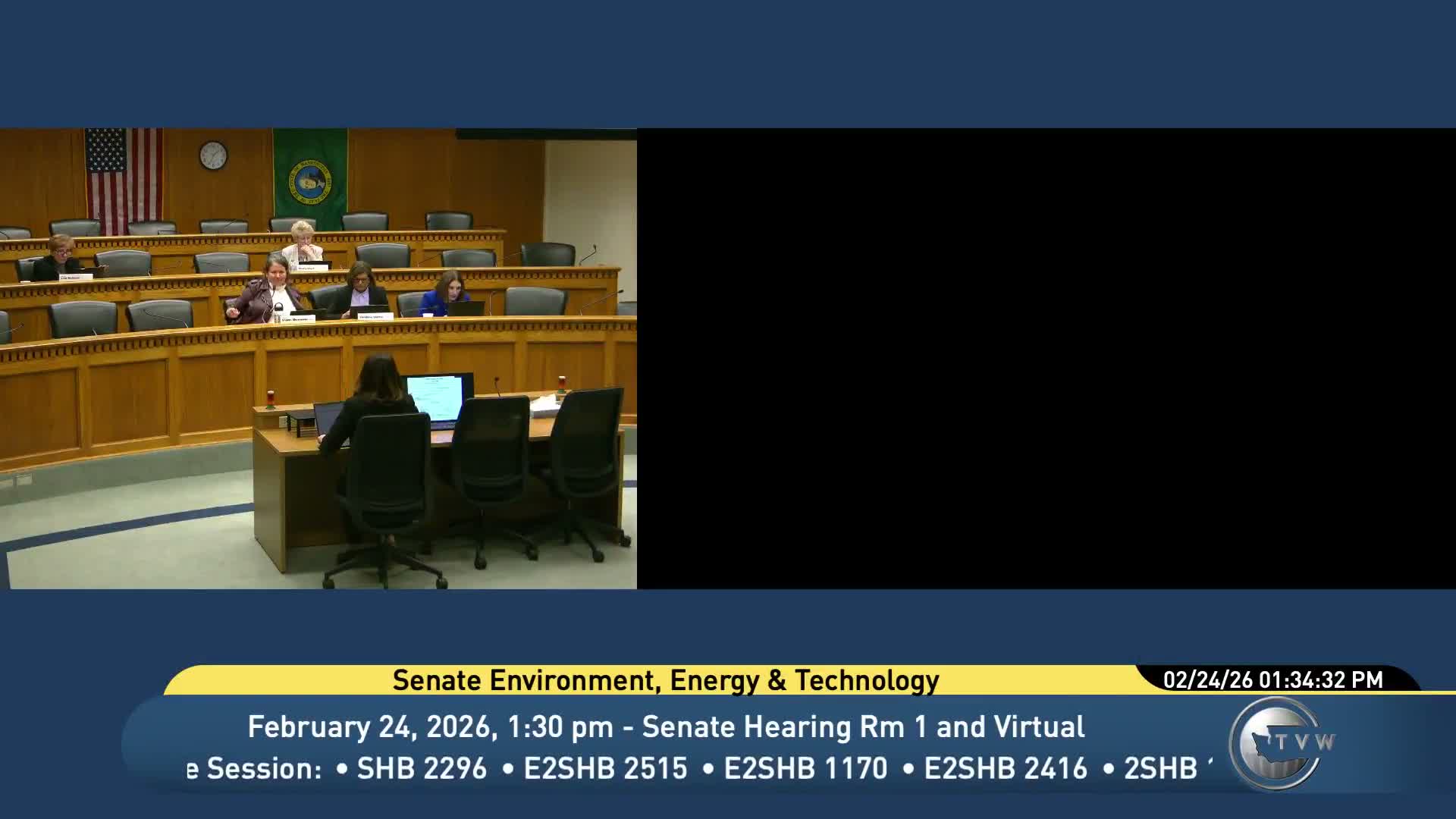
A Senate Energy, Environment and Technology Committee public hearing on Second Substitute House Bill 1906 drew four in-person testifiers who told lawmakers the measure would help customers understand future costs when small or aging water systems change hands.
Alicia Kinney Clawson, staff to the committee, opened the briefing on HB 1906 and described a striking amendment offered by Chair (Senator) Shoemake that would require public water systems to provide notification before a change in ownership, require Group A systems to submit planning and engineering documents to the Department of Health, and direct the Utilities and Transportation Commission (UTC) to adopt rules on rate determination that account for capital cost of service, external funding, and rate‑smoothing. Clawson said a fiscal note exists for a prior version but that updated cost information was not yet available.
Bill Clark of the Washington PUD Association urged support, saying the state has “literally thousands of very old and small water systems” often managed by homeowners or HOAs that will eventually need to be sold and professionally managed; the bill, he said, “improves the notice to the customers so they know what their options are … and it identifies to them what their future costs will be.”
Charlie Brown, representing Northwest Natural, described a purchase of the Cascadia system that required replacement of mains and reservoirs and substantial repairs imposed on the system’s previous owners. Brown said HB 1906 and proposed clarifying amendments that include forward‑looking cost projections would better inform water users about the magnitude of future required investments.
Kevin Vandeweg of Thurston PUD described the PUD’s experience assuming ownership of many small, failing private systems and noted Thurston PUD is constructing eight PFAS treatment systems to meet EPA maximum contaminant level requirements; he told the committee federal and state grants have funded much of the initial capital work but that ongoing operational costs will fall to ratepayers. Vandeweg said Thurston PUD strongly supports the bill’s notification provisions.
Senator Loveland pressed witnesses on whether the bill changes the receivership or relinquishment process for failed systems and how ratepayers—particularly low‑income customers in remote areas—would be protected from unaffordable bills. Supporters said the bill does not create a receivership mechanism but aims to provide upfront notice of required capital improvements and expected future rates so customers can make informed decisions before a sale or transfer of control.
Christine Brewer of Washington Water Service, a utility regulated by the UTC, said her company supports the striking amendment but requested clarifying language about UTC rate‑making processes; she said UTC staff had been consulted and she had sent the chair suggested clarifying amendments.
The committee closed the public hearing and entered executive session. During the executive session the committee adopted striking amendment F to HB 1906, moved the bill as amended, and the chair announced the bill passed subject to signatures and will be sent to the Ways and Means Committee.
Next steps: HB 1906 advanced out of the committee as amended and awaits further consideration by Rules/Ways and Means as applicable to its next step in the legislative process.