Get Full Government Meeting Transcripts, Videos, & Alerts Forever!
Get email alerts on the General Plan Safety Element topic
No spam. Unsubscribe anytime.
Plumas County planning staff outlines work plan to update overdue public health and safety element; state laws to be incorporated
Summary
Senior planner Tim Evans told the commission the county's 2035 general plan safety element is overdue and must be updated to comply with multiple state laws (including SB 379 and AB 2140). Staff described a staged timeline: drafting Feb'July 2026, planning commission workshops July'Aug 2026, Cal Fire formal review in Oct'Nov, and a general plan amendment process slated for 2027.
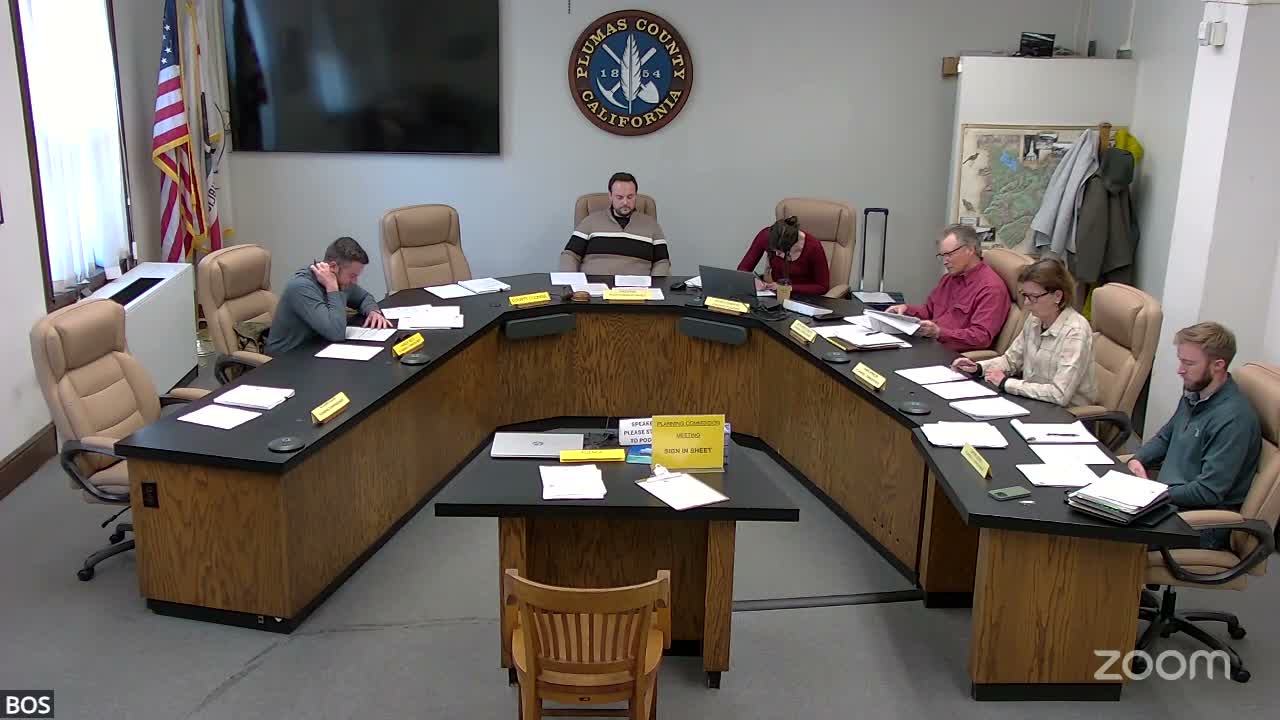
Senior planner Tim Evans presented the public health and safety element work plan and explained why Plumas County must update the 2035 general plan safety element. The county adopted the 2035 general plan in 2013 and, per state law, a safety element requires periodic updates; Evans said the county is about 12 years past the last update and must now incorporate new state requirements.
Evans listed eight state bills and statutes staff must address during the update, including SB 99 (evaluate residential developments in hazard areas lacking multiple evacuation routes), AB 162 (coordination with housing element updates), SB 379 (climate adaptation, requiring a climate-change vulnerability assessment), SB 1241 (addressing fire hazard risk in state responsibility areas and very high fire severity zones), AB 747 and AB 1409 (evacuation locations and evacuation-route capacity/viability requirements), AB 2140 (limits on state disaster-recovery funding unless a local hazard mitigation plan is adopted and incorporated), and AB 2684 (extreme-heat hazard to be addressed by 01/01/2028). Evans said staff is still evaluating whether SB 1000 (environmental justice) thresholds apply to the county.
Staff reported the county has already sent the existing safety element to Cal Fire (Board of Forestry) for initial assessment in July and received comments by September; staff plans to complete a draft public health and safety element incorporating those comments and the climate vulnerability assessment. The internal schedule Evans presented estimates staff drafting from February through July 2026, planning commission workshops and review between July and August 2026, final revisions in late summer 2026, formal Board of Forestry review in October'November 2026, and a full general plan amendment process to take the draft to the Board of Supervisors in 2027.
Public speakers urged faster and more ambitious action to address climate risk and structure hardening. "This county should have declared a climate emergency many, many years ago," said Josh Hart (Feather River Action), who called the staff steps "minimal" given extreme weather and fire risk. Several commissioners and staff acknowledged the workload and said staff will prioritize the items that must be completed immediately while sequencing the larger vulnerability and extreme-heat work.
Evans also noted that other ongoing processes (the housing element update and local hazard mitigation plan update) trigger elements of the safety element update and allow staff to incorporate existing local hazard data by reference where appropriate (for example, evacuation-route and evacuation-site planning). He emphasized interagency review requirements, naming the Board of Forestry and Fire Protection, California Geological Survey and the California Office of Emergency Services as agencies that will be asked to review and provide data for inclusion.
Staff did not request immediate action to adopt a final element at the meeting; instead, the commission received the work-plan briefing and public comment and directed staff to proceed with drafting and future workshops.