Get AI Briefings, Transcripts & Alerts on Local & National Government Meetings — Forever.
Plumas County planning commission reopens telecom ordinance after contested Greenville tower; public demands end to TPZ exemption
Loading...
Summary
At a planning commission workshop, staff reviewed Article 41 (telecommunications ordinance) after the Board of Supervisors asked for a code review following a controversial tower in Greenville. Residents urged removing the Timberland Production Zone (TPZ) exemption, expanding notice, increasing setbacks and imposing interim discretionary review; industry witnesses defended capacity needs and technical distinctions.
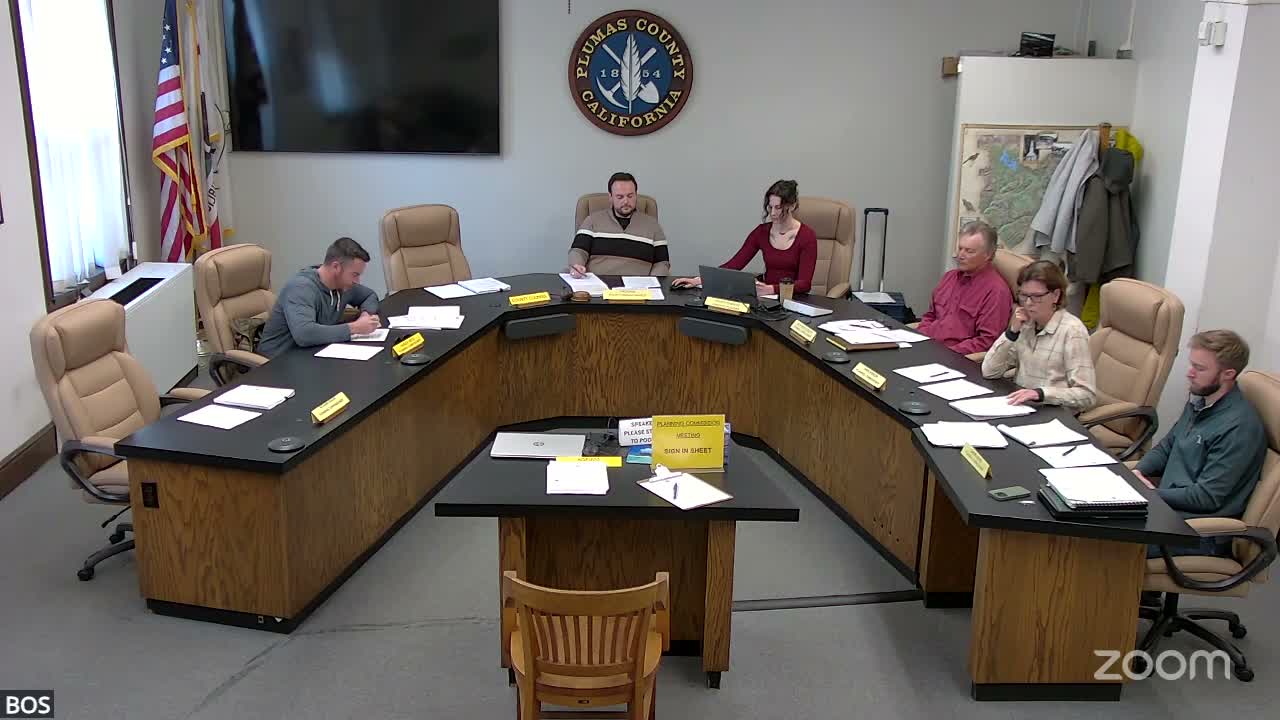
Planning staff opened a workshop on Article 41, the county's telecommunications ordinance, and described why the county is again considering changes after a Verizon facility built at 1006 Powerline Road proceeded under a TPZ exemption that exempted the site from Article 41's design, location and aesthetic rules. The Board of Supervisors adopted a resolution of intention late last year asking the planning commission to revisit exemptions, expand tribal review and widen public noticing beyond the statutory 300 feet.
The ordinance, staff said, was developed through 21 workshops from 2017 to 2019 and adopted in 2019; it includes sections on purpose, definitions, applicability, exemptions, application requirements and facility-removal rules. Planning staff highlighted two provisions that have drawn public attention: the exemption for parcels zoned Timberland Production Zone (TPZ) and the permit matrix that allows building permits for exempt TPZ sites rather than special-use discretionary review. Staff also explained application requirements that mirror federal standards, including an RF compliance report prepared in accordance with FCC OET-65 and signed by a licensed engineer.
Residents and local advocates told the commission the TPZ exemption led to the Greenville tower being constructed without planning review or neighbor notice. "We would have avoided unnecessary cell towers, unnecessary legal costs, just had the county listened to the public when they were speaking about this seven years ago," said Josh Hart, spokesperson for Feather River Action, who urged the commission to remove exemptions and require planning review for all new sites. Hart and other speakers said exemptions enabled industry editing of the ordinance and produced real harms including property-value loss and impacts to cultural sites.
Multiple speakers asked the commission to act quickly: remove the TPZ exemption, increase setbacks and expand public notice, and adopt an interim requirement that all new telecommunications facilities be subject to discretionary review while the code is revised. Citing legal and CEQA exposure, Dr. Cinnamon Jones Cruz urged a comprehensive, top-down review of related code sections and recommended a temporary interim rule to prevent irreversible siting decisions during the revision process.
Industry and technical witnesses described differing technical uses and safety calculations. Caitlin Bieber, speaking on behalf of a local telecom cooperative, said fixed wireless point-to-point services use different frequencies and operate to different FCC safety thresholds than cellular 5G deployments, and argued that some fixed wireless installations are necessary to close the digital divide in rural areas. A radio-frequency engineer explained the FCC'required worst-case calculations and time-averaging used to assess human exposure under OET-65.
Planning staff said the workshop is the start of a public process: staff will compile written comments (roughly a dozen were included in the packet), digest public testimony, then return to the commission with proposed code changes for further workshops and a recommendation to the Board of Supervisors. Staff framed the meeting as a listening session and flagged specific code topics to review: TPZ exemptions, public noticing distances, tribal consultation provisions and any other loopholes in Article 41.
The commission did not adopt ordinance language at the workshop; instead, commissioners and staff signaled they will consider public input in drafting amendments and return with formal proposals and hearings later in the code-amendment process.