Lifetime Citizen Portal Access — AI Briefings, Alerts & Unlimited Follows
Senate committee advances bill to create state research institute, authorize $6 billion in bonds
Loading...
Summary
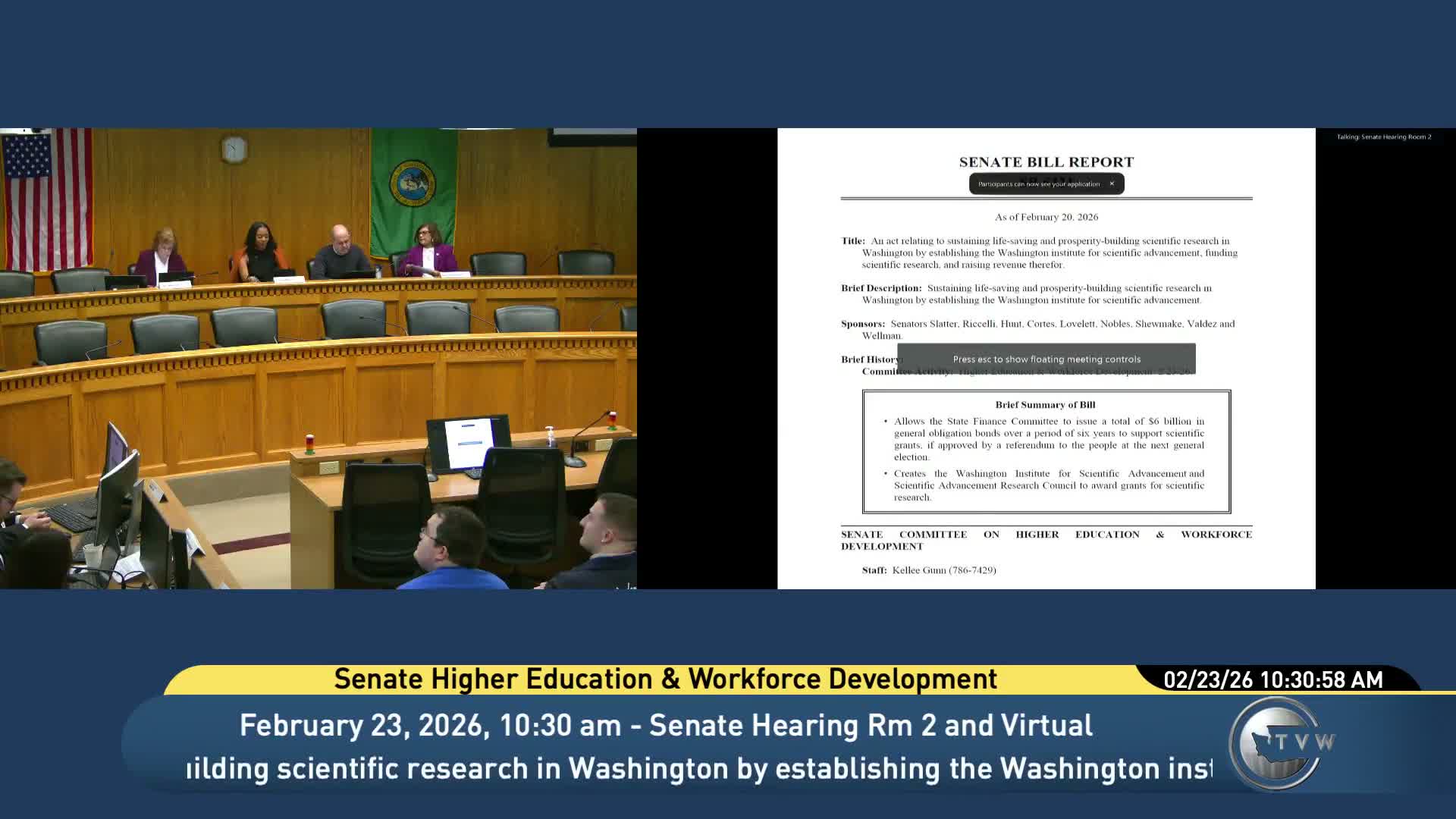
The Senate Higher Education and Workforce Development Committee advanced SB 6321, which would create the Washington Institute for Scientific Advancement and authorize up to $6 billion in general-obligation bonds to back state research grants and facilities; witnesses from UW, WSU and unions said federal funding cuts have destabilized research careers and projects.
The Senate Higher Education and Workforce Development Committee recommended SB 6321 “do pass” after a public hearing in which university leaders, early-career researchers and union representatives urged the Legislature to provide a backstop for federal research funding.
Kelly Gunn, committee staff, told members the bill would authorize the state finance committee to issue up to $6,000,000,000 in general-obligation bonds, with issuance limited to $1,000,000,000 per year for six years beginning in 2027, and would create the Washington Institute for Scientific Advancement within the Department of Commerce to award grants and support research facilities. Gunn said sections of the act that create the institute and authorize the debt must go to voters at the next general election under the Washington State Constitution.
Senator Slaughter, the bill’s prime sponsor, framed SB 6321 as a response to what she described as “dangerous and politicized attacks against research funding.” She argued the measure would protect jobs and the state’s research ecosystem, saying Washington “brings in over $3,200,000,000 in federal research funding” and that state backing could preserve long-term competitiveness.
Representatives from the state’s public research institutions and research community testified in favor. Connor Haggerty of Washington State University said state investments leverage federal and private dollars and generate jobs and commercialization. Shelly Sakiyama Albert, vice dean for research at the University of Washington School of Medicine, testified UW’s School of Medicine accounted for about $885,000,000 in research last year and that two-thirds of UW’s research funding comes from the federal government; she said new NIH awards fell about 40% in federal fiscal year 2025 and that funding uncertainty “threatens the research training pipeline.”
Early-career researchers described concrete effects. Casey Gervin, a neuroscientist, said her MOSAIC early-career award from the National Institute on Drug Abuse was terminated without scientific concerns cited and that the loss destabilized her transition to an independent research career. Aaron Pelley, a Ph.D. candidate at Washington State University, said funding freezes harmed applied climate and fisheries work that partners with tribes and conservation districts. Lucas O’Brien, a UW research scientist in psychiatry, said grant renewal delays led to furloughs and paused services for vulnerable populations.
Other witnesses described impacts across fields, including forest-fire resilience research and clean-energy commercialization. Rachel Woods Robinson of UW’s Clean Energy Institute said a 30% cut to the Solar Energy Technologies Office reduced graduate support, while UAW Local 4121 vice president Abigail Gambrell said membership layoffs and disruptions had risen amid funding instability.
After executive session, the committee moved SB 6321 for a due-pass recommendation and sent it to the Rules Committee by voice vote; the committee recorded the bill as passed “subject to signatures.” The committee also voted by voice to recommend confirmation of a slate of gubernatorial appointments, subject to signatures.
The bill would require a public referendum before the state issues the general-obligation bonds that fund the institute and its grants, and the fiscal note (filed with the bill) is the staff-recommended source for detailed projections on interest rates and debt-service costs. Committee staff told members the fiscal note indicates bonds under this proposal would not be tax-exempt, which increases borrowing costs.
Next steps: SB 6321 is headed to the Rules Committee with a due-pass recommendation; the act’s sections that create the institute and authorize the debt must be submitted to voters for ratification if the Legislature adopts them.