Get AI Briefings, Transcripts & Alerts on Local & National Government Meetings — Forever.
Minnesota higher-education witnesses urge funding for automated ID checks to curb ‘ghost student’ fraud
Loading...
Summary
Minnesota State officials told the House Higher Education Finance and Policy Committee that fraudulent "ghost student" enrollments siphon federal and state aid and recommended investing roughly $1–1.5 million annually in automated identity-proofing across 33 institutions, plus annual reporting and equity reviews.
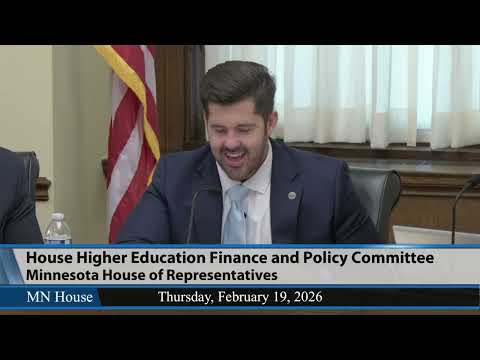
At an April 21, 2025 hearing of the Minnesota House Higher Education Finance and Policy Committee, Craig Munson, chief information security officer for Minnesota State Colleges and Universities, described a rise in so-called "ghost students" — fraudulent enrollments created with stolen or fictitious identities that can be used to obtain Pell Grants and other aid. Munson said the working group convened under last year’s session law has recommended technical and process improvements, including an automated identity-proofing system for all 33 Minnesota State institutions.
The recommendations matter because fraudsters conducting large-scale automated campaigns can divert federal and state financial aid and compromise institutional IT resources, Munson told the committee. "Ghost students are fraudulent enrollments created using stolen or fictitious identities," he said, and the system detects "thousands" of attempted fraudulent enrollments, though he declined to give detailed public counts at the hearing to avoid tipping off attackers. He recommended annual legislative reporting on trends, formalizing the fraud working group, enhanced staff training and equity impact assessments before new tools are implemented.
The working group’s report, Munson said, documents both manual and technical safeguards already adopted and identifies automated identity proofing as the most impactful next step. The estimated recurring cost for an automated proofing system — including acquisition, implementation, support and maintenance — was given as roughly $1,000,000 to $1,500,000 per year. "An automated identity proofing system will dramatically speed up and expand on the manual identity-proofing processes that we're already doing today," Munson testified.
Members pressed for more detail on scope and cost. Representative Robbins asked for aggregate counts of attempts, the number that succeeded, and the fiscal impact on Pell Grants and state aid; Munson said that the number of detected attempts was "in the thousands" and offered to provide aggregated figures to members offline. Munson also told members the enrollment fraud user guide had been published and shared systemwide but acknowledged that full implementation across all campuses remains in progress.
Faculty witnesses told the committee that safeguards have reduced incidents but left operational gaps at the classroom level. Mark Grant, who represents Minnesota State College Faculty, said faculty have seen a significant decline in ghost-student enrollments but still lack clear, consistent guidance about steps to take when suspicious enrollments slip into a specific course. "We're still struggling with what to do on a course-specific level," Grant said, adding that faculty are reluctant to become de facto cybersecurity specialists and need explicit, practicable expectations and resources.
Representatives of the University of Minnesota and the Minnesota Private College Council described verification processes used at their institutions. Meredith Fergus, a financial-aid analyst for the University of Minnesota, said admissions and summer transcript verifications can lead to rescinded admission offers when identity checks fail; Paul Serkvinick, president of the Minnesota Private College Council, said most private residential institutions have seen limited fraud but are tightening identity verification.
The committee did not take further formal action on funding at the hearing. Members asked Minnesota State for follow-up materials including aggregate counts of attempts and the portion that drew aid, timing on suspicious-account freezes after disbursement, and more detail on user-guide implementation. The committee adjourned at the end of the hearing.
Next steps: Minnesota State said it will provide members with follow-up data and the committee signaled interest in considering funding and oversight measures to support automated proofing and continued training.