Lifetime Citizen Portal Access — AI Briefings, Alerts & Unlimited Follows
SLAC project director outlines LCLS‑II HE upgrade to double accelerator energy and add hard x‑ray capability
Loading...
Summary
Greg Hayes, project director for the LCLS‑II HE project at SLAC National Accelerator Laboratory, said the upgrade will double accelerator energy by adding 23 cryomodules, convert LCLS‑II to hard x‑rays, and builds on the 2023 LCLS‑II expansion that increased pulse rate to about 1 million per second.
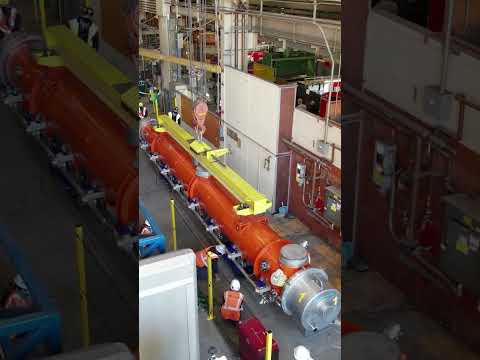
Greg Hayes, project director of the LCLS‑II HE project at SLAC National Accelerator Laboratory, described plans to double the energy of the LCLS‑II accelerator by installing 23 additional cryomodules and converting the facility to produce hard x‑rays. "With the HE upgrade, we're gonna double the energy of the accelerator by adding only 23 more cryomodules," Hayes said.
Hayes placed the HE upgrade in recent context, noting the LCLS facility was first built in 2009 and that the LCLS‑II upgrade, completed in 2023, greatly increased experimental throughput. "The LCLS‑II upgrade... advances the laser capability by going from a 100 pulses a second to 1,000,000 pulses a second, allowing us to serve more scientists," he said. He added that the LCLS machine extends about 4 kilometers across the hillside and used components derived from SLAC’s original accelerator, installed in the 1960s.
As background on hardware changes, Hayes said the LCLS‑II build added 37 cryomodules to create a roughly 4 GeV electron accelerator. He described the HE upgrade as achieving a doubling of energy with fewer additional modules because cryomodule technology has advanced in the last decade and each unit now delivers greater performance. "We're actually doubling the machine with fewer cryomodules because the technology has advanced in the last 10 years that we can get more performance out of the same units," he said.
Hayes said converting LCLS‑II to hard x‑rays will let researchers probe deeper inside materials and create three‑dimensional images and real‑time movies of internal processes. He framed the project as a collaborative effort among national laboratories, saying it represents "the culmination of 5 US national laboratories coming together" — naming Berkeley Lab, Fermilab, Jefferson Lab, Argonne and SLAC — and noting the work is being delivered for the Department of Energy as a roughly $1 billion‑class facility.
Hayes’ remarks in this presentation focused on the technical scope and collaborative scale of the LCLS‑II HE upgrade. He did not specify a construction schedule, final cost authorization, or regulatory approvals in the provided remarks.