Get Full Government Meeting Transcripts, Videos, & Alerts Forever!
Get email alerts on the Transmission Preemption topic
No spam. Unsubscribe anytime.
FERC chairman highlights TransSource dispute, says PJM/AEP preemption claim is ‘utterly outrageous’
Summary
At a FERC press briefing, the chairman filed a concurrence on item E11 documenting history around PJM's TransSource transmission project and criticized a federal lawsuit in which PJM and TransSource (majority-owned by AEP) argue that inclusion in PJM's regional plan preempts state certificate (CPCN) authority.
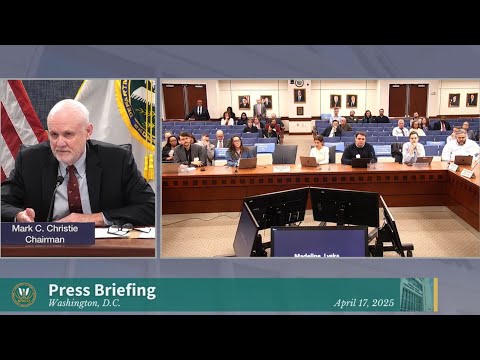
The Federal Energy Regulatory Commission's chairman used opening remarks at a press briefing to explain a concurrence he filed on item E11, laying out the agency's historical record in a dispute over the TransSource transmission project and pressing a legal point now before federal courts.
The concurrence, the chairman said, records that PJM placed the TransSource project in its regional plan in 2016'2017 but that the Pennsylvania Public Utility Commission later rejected the project in a certificate of public convenience and necessity (CPCN) proceeding. He said PJM and the developer, TransSource (majority owned by American Electric Power), then sued in federal court arguing that placement in the regional plan preempts state review. "The very fact it went into the regional plan preempts the states...which I think is really, utterly outrageous," the chairman said, arguing the litigation position conflicts with earlier stipulations and state commissions'orders.
Why it matters: the litigation tests the boundary between regional transmission planning and states'authority to grant or deny CPCNs for infrastructure in their jurisdictions. If a court accepts the preemption argument, states'ability to evaluate need through their certificate processes would be curtailed.
The chairman said he included quotations from past Virginia commission orders in the concurrence and recounted that in 2004, PJM and AEP'affiliated companies explicitly agreed that joining PJM did not alter their obligation to seek state CPCNs. He argued that those prior commitments are inconsistent with the position PJM and the developer are asserting in federal court now.
The statement also connected the dispute to a broader debate at FERC over incentives tied to joining regional transmission organizations and the agency's historical policy choices. The chairman framed the filing as a record-setting step to ensure the agency's past public orders and parties'stipulations are visible to courts and stakeholders.
No formal agency action or vote on this point was announced at the briefing; the underlying federal litigation remains pending.