Get Full Government Meeting Transcripts, Videos, & Alerts Forever!
Get email alerts on the Mlc Programmatic Restructuring topic
No spam. Unsubscribe anytime.
Portland SD 1J staff outline plan to end Metropolitan Learning Center high school grades, drawing sharp community protest
Summary
District staff told the board they plan to discontinue Metropolitan Learning Center's 9—12 programming because enrollment has fallen to roughly 38—1 students and the district faces large budget shortfalls; students, alumni and parents urged a pause and more engagement.
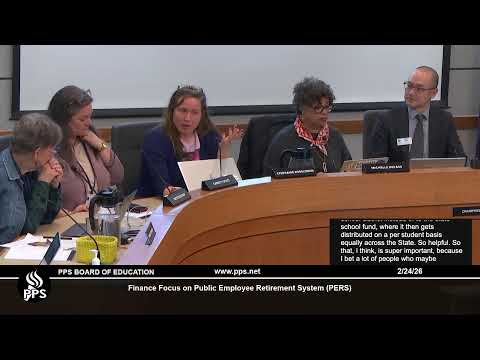
Superintendent Armstrong and district staff told the Portland SD 1J board on Feb. 24 that they plan to discontinue Metropolitan Learning Center's grades 9—12 programming, citing long-term enrollment decline and the district's budget shortfall. Staff said the high school enrollment has fallen to about 38—1 students and that small-program staffing makes comprehensive high school programming unsustainable.
The district's senior chief of academics, Christina Howard, presented 10-year trend data showing MLC's 9—12 enrollment is less than half of what it was a decade earlier and that only about 6 percent of MLC grade-8 students matriculate into the MLC high school. A data presenter said reaching typical PPS staffing ratios would require dozens more students: "To reach the median PPS FTE per student level for grades 9 through 12, MLC would need to enroll 136 students," staff said during the presentation.
The presentation said instructional staffing allocations projected for MLC next year would leave the program unable to offer a broad range of courses, stable staffing and individualized supports that define strong alternative programs. Staff estimated discontinuing the MLC 9—12 program would save roughly $1,100,000 in recurring annual instructional staffing costs.
Student speakers and community members urged the board to pause. Milo Wade, a current student, told the board: "I fear you don't care. It shows." Student Nick Pfeiffer said MLC provides safety for queer and disabled students and cited the school's internal outcomes: "MLC has an 80% graduation rate compared to Alliance's 40%." Alumni and parents, including Allison Mosher, said the school is a unique, life-saving program and noted more than 2,100 signatures on an online petition in support of preserving the high school program.
During board discussion, several directors expressed sympathy for MLC families while stressing the district's constrained finances. Director Sullivan, who taught at MLC for two decades, said the closure came with personal regret but noted the board must weigh systemwide needs. Directors repeatedly referenced the larger funding context, including state-level funding shortfalls and Measure 98 allocations, which staff said have dipped recently.
Staff said the district had confirmed, with outside counsel and the Oregon Department of Education, that MLC K— is a single school for statutory purposes; district counsel explained that eliminating grades 9—12 differs from a full school closure under ODE rules but acknowledged the policy and interpretation complexity. Several board members asked staff to return fiscal-impact details and asked whether the decision could be included in the larger rightsizing or consolidation review the district plans to carry out.
No formal board vote on ending MLC's 9—12 programming occurred at the work session. Staff said the board votes on the annual budget in June and that any final resource allocations would be part of the district's larger budget process. Staff also described reconnection services and partner community-based organizations (Rosemary Anderson Prep, Helen's View, NAOM/NEA) that would work with families and offer placement or individualized meetings. The district said it would prioritize MLC students for placement lotteries at Jefferson, Benson and Alliance and arrange tours and supports to help students transition.
The board asked for a fiscal-impact statement and additional demographic and staffing analyses, and several directors urged greater community engagement on similarly consequential rightsizing decisions in the future. The superintendent and staff committed to providing more data and to continuing the districtwide review of programs and staffing amid the projected budget shortfall.